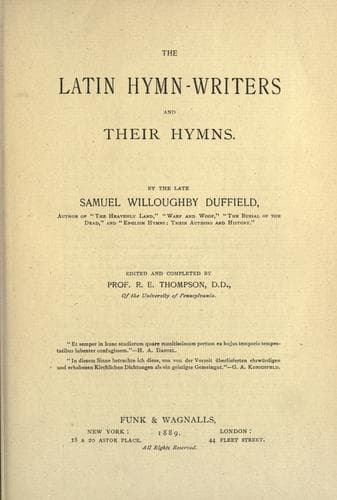
The Latin Hymn-writers and Their HymnsDuffield, Samuel Willoughby
Religion
The Latin Hymn-writers and Their Hymns
Duffield, Samuel Willoughby
Hymns, Latin -- History and criticism
2. From 1 Corinthians 14:23-33, it seems plain that the composition, as
well as the singing of these hymns and songs, might be the result of
sudden emotion or inspiration. In any case, there is no doubt (for
Tertullian decisively states it) that the “extempore,” or, more
strictly, “private” authorship of such psalmody was not uncommon. The
council of Laodicea (_circa_ A.D. 360) interdicted private persons from
this privilege. Even in Paul’s time it would appear to have produced an
effect akin to the “spirituals” of our own freedmen—much of it being
exquisite in its simple devotion, while a certain share offended good
taste, and hindered the propriety and solemnity of worship.
3. The alternation of prayer with praise was never better illustrated
than when Paul and Silas (Acts 16:25) sent up their midnight anthems
from that “inner prison,” while their feet were “made fast in the
stocks.” This alternation was—as the Fathers assure us—the order in
public worship also.
4. We have received in the very pages of the New Testament some of these
earliest hymns. To say nothing, at present, of those great leading
chants which bear the names of the angels, and of Mary, and of
Zacharias, and of Simeon—and to pass over all those of Jewish origin—we
have still left us such a strain as that in Acts 4:24-30. Here we have
an impulse which expresses itself in reply to Peter and John by sacred
song.
Ephesians 5:14 has also been considered to be such a fragment:
“Awake, O thou that sleepest!
Arouse thee from the dead!
And Christ shall give to thee
Enlightenment!”
So too 1 Timothy 3:16 has been arranged by some scholars as though it
were a well-known strophe the Apostle quoted:
“Who—for the mystery is great—
Was manifest in body,
Was justified in spirit,
Was visible to angels,
Was heralded to heathen,
Was trusted on the earth,
Was taken up to glory.”
Nor is this the only instance in this very Epistle, for 1 Timothy 6:15,
16, reads:
“The king of all the kingly ones,
The lord of all the lordly ones,
Who only hath the power of life immortal;
Inhabiting the unapproachable light;
Whom never any one of men hath seen,
Nor ever can behold;
Let glory and eternal strength be his!
Amen!”
Public-domain text, read in full here on John Shaqi.
Reviews
Reviews
No reviews yet
Be the first to share your thoughts on this work.
Join the Discussion
Join the discussion
Sign in to leave a comment or review.
Sign InorCreate an account