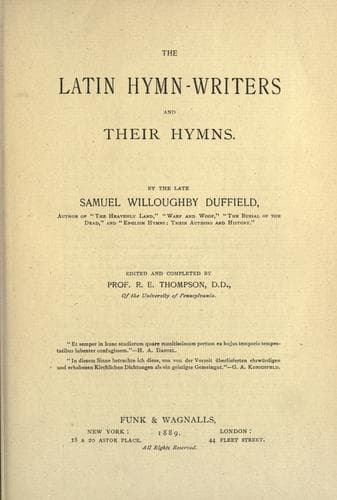
The Latin Hymn-writers and Their HymnsDuffield, Samuel Willoughby
Religion
The Latin Hymn-writers and Their Hymns
Duffield, Samuel Willoughby
Hymns, Latin -- History and criticism
How the monk ever found time for his accomplishment of study and writing
among his constant labors—his chanting and his teaching and his frequent
preparation of homilies—it is indeed hard to discover. But he wore away
the thin scabbard of the body by the keen edge of his sheathed and
unsheathed mind, until he died before his days were truly done. How
often must we lament the incredible monotony and weary routine of these
noble lives! How much more, we say to ourselves, they could have
achieved under better and freer conditions! But perhaps not. Perhaps
this very constriction was a source of strength; and perhaps the severe
stress which finally broke this noble student was, after all, the
creator of his best powers and the director of his finest energy.
Did he ever visit Rome? Monks from the Anglo-Saxon monasteries went on
pilgrimage back and forth, but if he went with them neither he nor they
have mentioned it. Yet there is a letter of Pope Sergius to Ceolfrid
which hints at such a journey, and might easily furnish a ground for the
opinion. On the whole, we must consider Bede as an unflickering light,
burning itself away at Jarrow, but illuminating all England with its
rays. It is not because of deficiency in acquirement that we deny these
traditions. He knew all that was then current. His writings are an
encyclopaedia of universal learning. Honorius of Autun says of him,
_scripsit infinita_—he wrote incalculably much. Lanfranc cites his
_Ecclesiastical History of the English Nation_. Alcuin compares him to
the Younger Pliny, and quotes him with great delight as “Magister Beda.”
The hymns ascribed to the Venerable Bede, on what appears to be good
authority, are the following:
_Adesto, Christe, vocibus_,
_Apostolorum gloriam_,
_Emitte, Christe, Spiritum_,
_Hymnum canamus gloriae_,
_Hymnum canentes martyrum_,
_Illuxit alma seculis_,
_Nunc Andreae sollemnia_,
_Praecessor almus gratiae_,
_Praecursor altus luminis_,
_Primo Deus coeli globum_,
_Salve tropaeum gloriae_.
Also, but more doubtfully:
_Apostolorum passio_,
_Inter florigeras_.
His Ascension hymn,
_Hymnum canamus gloriae_,
in its abbreviated form, spread beyond the bounds of English use, and
found favor with the Churches of the Continent. It has simplicity and
directness, if not much poetic force and is too prolix for Church use in
its original form. Mrs. Charles’s version, “A hymn of glory let us
sing,” is well known. Next to it stands his
_Hymnum canentes martyrum_,
known to English readers by the admirable version in _Hymns Ancient and
Modern_, which begins, “A hymn for martyrs sweetly sing.” A third
notable hymn is that to the Cross:
_Salve tropaeum gloriae_,
in which he embodies the beautiful legend of St. Andrew’s death.
Public-domain text, read in full here on John Shaqi.
Reviews
Reviews
No reviews yet
Be the first to share your thoughts on this work.
Elsewhere in the archive
Join the Discussion
Join the discussion
Sign in to leave a comment or review.
Sign InorCreate an account