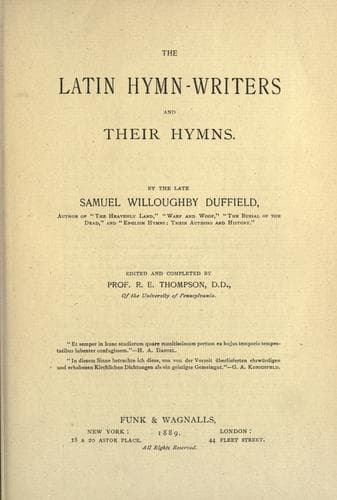
The Latin Hymn-writers and Their HymnsDuffield, Samuel Willoughby
Religion
The Latin Hymn-writers and Their Hymns
Duffield, Samuel Willoughby
Hymns, Latin -- History and criticism
With such a patron as Biscop the monasteries never lacked any good
thing. He brought back from the Continent the best matters of the
period—books, pictures, relics, skilled mechanics, makers of stained
glass, and choir-masters. He saw before him a land in which the monk was
to be the conservator and promoter of learning. And in carrying out this
purpose he did more than plant a monastery, for he planted and reared a
man. We have the word of that historian whose life and death so nearly
approach those of his favorite author, when we declare that “prose took
its first shape in the Latin history of Baeda.” For John Henry Greene
closed his history of the English people much as Bede ended his own
career, weary with his labor and yet completing what he had begun.
That which lies before us is what Greene finely styles “the quiet
grandeur of a life consecrated to knowledge.” It was no hoarding,
avaricious, trilobite life to be fossilized for future ages in the dead
strata of ecclesiastical records. Instead, it concerned itself with all
learning; and though it perished in the blackness of a general
ignorance, it is a source of light and force to-day.
But let us return to Bede’s brief points of change. While he was still a
boy, the monastery was desolated by one of the great plagues which
followed the Synod of Whitby, and every monk who knew how to sing in the
choir, except the Abbot and Bede, were among the victims. Unaided these
two struggled with the double task of teaching the others to sing and
keeping up the monastic services in the mean time. The antiphons they
had to abandon, but they struggled through the Psalms, often weeping and
sobbing as they sang. At nineteen—six years before the usual age—he
became a deacon; at thirty he was a priest; at fifty-nine he died. He
acquired his Greek through the agency of Archbishop Theodore, who had
come from Paul’s city of Tarsus in Cilicia. There were many in England
who actually spoke in that tongue, owing to his encouragement of it. And
Bede was no mean nor small factor in its diffusion, for he taught at
Jarrow a school of six hundred monks, besides an uncounted number of
strangers who sought his instruction. The genealogy of school masters is
truly suggestive. From Bede to Alcuin, from Alcuin to Rabanus Maurus,
from Rabanus and his liberal methods on to the times of Abelard and the
free inquiry; so the torch of learning passes down the generations. And
when we remember Alcuin’s commendation of Bede and Rabanus Maurus’s
instruction by Alcuin, we cannot doubt the close connection of these
three earliest names. Abelard really revived the bolder and broader
style which had been opposed at first in the Abbey of Fulda.
Public-domain text, read in full here on John Shaqi.
Reviews
Reviews
No reviews yet
Be the first to share your thoughts on this work.
Elsewhere in the archive
Join the Discussion
Join the discussion
Sign in to leave a comment or review.
Sign InorCreate an account