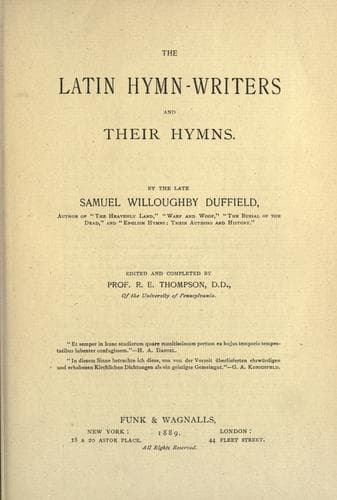
The Latin Hymn-writers and Their HymnsDuffield, Samuel Willoughby
Religion
The Latin Hymn-writers and Their Hymns
Duffield, Samuel Willoughby
Hymns, Latin -- History and criticism
This Hatto was not the infamous bishop of the Rat Tower whom Southey has
immortalized in blood-curdling verses. That notorious prelate was indeed
Abbot of Fulda and Bishop of Mainz, but he died in 969 or 970, and the
swarming rats which devoured him for his avarice in keeping the corn
from the poor owe their original celebrity to those curious volumes, the
_Centuries of Magdeburg_. So far as we can discover, the Hatto who
accompanied Rabanus became neither famous nor infamous, unless it be
something to have obtained the abbacy of Fulda when his friend laid it
down.
In 804 Rabanus returned to Fulda. He had profited by the instruction he
had received, and was now the fittest person to be put at the head of
the school in the cloisters. To his original name the old teacher had
affixed the honorable title Maurus, and to this again Rabanus himself
added the descriptive adjective Magnentius. So that Rabanus Maurus
Magnentius is the full appellation of the man henceforth to be styled
with the largest truth, _Primus Germaniae preceptor_. This giving of
names was one of the features of those times. Alcuin was called Albinus
Flaccus, Paul Winfrid was known as Bonifacius, and Ratbert, the advocate
of transubstantiation, became Paschasius. Besides this, the spelling of
proper names was very much at sea. Thus, to the R of Rabanus there was
prefixed or suffixed a Greek “rough breathing,” making it HRabanus or
Rhabanus, precisely as we some times find HLudovicus or HLotharius.
It is at this time that the true skill and ability of Rabanus appear
before us. He was the first person to establish a school in Germany
which had in it the promise of modern education. He allowed pupils to
attend and be trained in the cloisters who had no vocation for a
monastic life. In point of fact he was the real founder of the school
system of Germany, and his fellow-countrymen have not been slow to
accredit him with the achievement. His life and accomplishments have
employed the pens of Buddeus, Schwarz, Dahl, Bach, Kunstmann, Spengler,
Köhler, Richter, and other writers on the history of _paedagogik_.[7] It
is beyond debate that the school at Fulda was a most remarkable place.
Rabanus was not the only teacher in the school. He was assisted by his
faithful friend Samuel of Worms, a fellow pupil under Alcuin. Together
these men developed and enlarged the minds of many of the future nobles
of Germany, and laid in Bible study and in the advanced opinions which
they announced, the foundations for a nation the most scholarly of any
on the earth. In these classes were to be seen such disciples of the new
learning as Walafrid Strabo, Servatus Lupus, Einhard (who subsequently
sent thither his son Wussin), and Rudolf who wrote the life of his
preceptor.
Public-domain text, read in full here on John Shaqi.
Reviews
Reviews
No reviews yet
Be the first to share your thoughts on this work.
Elsewhere in the archive
Join the Discussion
Join the discussion
Sign in to leave a comment or review.
Sign InorCreate an account