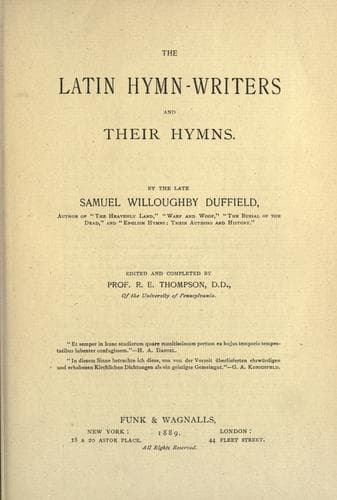
The Latin Hymn-writers and Their HymnsDuffield, Samuel Willoughby
Religion
The Latin Hymn-writers and Their Hymns
Duffield, Samuel Willoughby
Hymns, Latin -- History and criticism
Leaving the manner of that ancient school life for the present, we are
struck with astonishment at the broad and liberal tone of the
instruction. Rabanus followed Bede in providing an encyclopaedia of
human knowledge for his pupils. He entitled it _De Universis_ and based
it on the previous work of Isidore of Seville. Additionally he abridged
the grammar of Priscian, a treatise which furnished, even as late as the
days of Richard Braythwaite and his _Drunken Barnabee_, the suggestive
line,
“Fregi frontem Prisciani.”
“I’ve broke Priscian’s forehead mainly.”
He also furnished a text-book in arithmetic, drawn mostly from Boethius,
and an etymology in which he depends to some extent on Isidore. He
utilized Bede for chronology, and Gregory for ecclesiastical forms, and
Augustine for doctrine, and Cassiodorus for commentary and exegesis.
Moreover, he was free from much of the superstition of his age. He
objected to giving the liver of a mad dog to one who had been bitten by
it—that being then held a perfect cure. His letters show an independent
and almost an audacious mind. In all religious discussion his motto was,
“When the cause is Christ’s, the opposition of the bad counts for
naught.” In statecraft—for ecclesiastics were chief movers in these
affairs—he held with Ludwig the Pious. He wrote a great deal in the way
of Scripture commentary, and his intellect was of a mystical order. He
delighted in allegories, in enshrining the bones of saints and
confessors, and in making the most marvellous and intricate anagrams and
arrangements of verses and letters upon the subject of the Holy Cross,
whose praise he has elaborately set forth. Wimpfeling may well style
this production a “wonderful and highly elaborate work.” It dates from
the year 815, and no modern reader can view it without dismay at its
enormous expenditure of labor.
A man like this in the teacher’s seat of Fulda would not be long in
obscuring by his manifest talents the feebler light of his abbot. So
Ratgar found, and devoted himself and his monks with mistimed zeal to
the erection of a great addition to the cloister church. He grudged the
time given to the studies of the school. He would much prefer to have
had the full control of all that was passing in the cloisters, but this
was plainly impossible. So he devised a very satisfactory way of
interrupting the success of Rabanus. He took the books from the scholars
and he even forbade them to the teacher. This was the cause of some
pathetic verses in which Rabanus sets forth his petition for their
return. “Let thy clemency,” he exclaims, “concede me books, for the
poverty of knowledge suffocates me.” One grates his teeth in reading
farther on the words, “Whether you do this or not, yet let the divine
power of the Omnipotent always afford you all good things and complete a
good fight with an honest course, that you may ever be with Christ in
the height of heaven.”
Public-domain text, read in full here on John Shaqi.
Reviews
Reviews
No reviews yet
Be the first to share your thoughts on this work.
Elsewhere in the archive
Join the Discussion
Join the discussion
Sign in to leave a comment or review.
Sign InorCreate an account