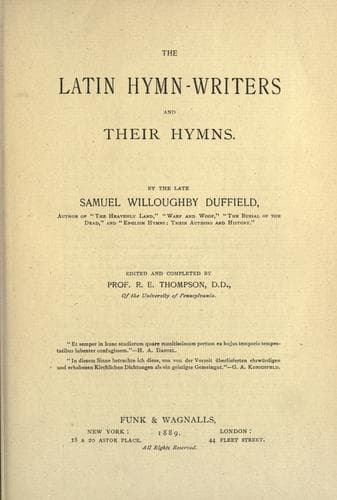
The Latin Hymn-writers and Their HymnsDuffield, Samuel Willoughby
Religion
The Latin Hymn-writers and Their Hymns
Duffield, Samuel Willoughby
Hymns, Latin -- History and criticism
Ratgar was a tyrant; there was no doubt of that. The only question was
how long this tyranny would survive the loss of students and the
defection of the monks, who had already begun to complain and resist.
There was not any hope, however, that this line of conduct would be
materially altered, and here again we have verses of Rabanus, lamenting
in moving terms the loss of scholars and the demoralization of the
school. It is not at all unlikely that the praises of the Holy Cross
were the solace of the poor pedagogue who had lost his favorite volumes.
He could scarcely otherwise have found the leisure for this elegant
trifling.
The poem just mentioned is imperfect. It breaks off abruptly and the
conclusion is missing. What it may have had to do with the outcome of
Ratgar’s tyranny we therefore cannot say, but the times upon which the
monastery had fallen were very grievous; and in 807 there was a
pestilence which depleted the list of monks from four hundred down to
one hundred and fifty, and these must, of course, have been more pressed
by the manual labor than ever. They toiled as did Israel in bondage, and
yet the end had not come. It was a period of the worst sort of misrule,
paralleled later at Cluny and not unknown in other conventual
establishments. In 814 Rabanus was ordained priest on December 23d, and,
as is supposed, after his withdrawal for a time from the monastery to
the refuge offered by a friend’s house. From a passage in one of his
commentaries it has been inferred that he used this suspense of his
labors to make a journey to Palestine.
In 811 there was, says Dahl, a great confusion (_Verwirrung_) in the
cloister. A libel was sent to Charles the Great criticising the conduct
of Ratgar—“libel” being used in its old sense of “little treatise.”
Nothing, as it would seem, was done about this, although the ordination
of Rabanus may have been a link in the chain.
But when Ludwig the Pious (Ludwig der Fromme) came to the kingdom Ratgar
was summarily deposed, and Egil, a kindly, book-loving man, created
abbot in his stead. This occurred in 817, three years after Ludwig began
to reign. All difficulties were now over. The school was reopened with
greater prosperity than before. The library was increased. The secular
scholars were taught outside the walls, for the number of students
surpassed the accommodation. And, in a word, Ratgar had merely held back
a constantly augmenting torrent which now poured itself in in an
intrepid tide. When Martin Luther, centuries later, cries out for
intelligent instruction and for the extension of the school system of
Germany, he is but repeating the cry which swelled in the ears of Ratgar
and drove him before it with execration from his abbacy.
Public-domain text, read in full here on John Shaqi.
Reviews
Reviews
No reviews yet
Be the first to share your thoughts on this work.
Elsewhere in the archive
Join the Discussion
Join the discussion
Sign in to leave a comment or review.
Sign InorCreate an account