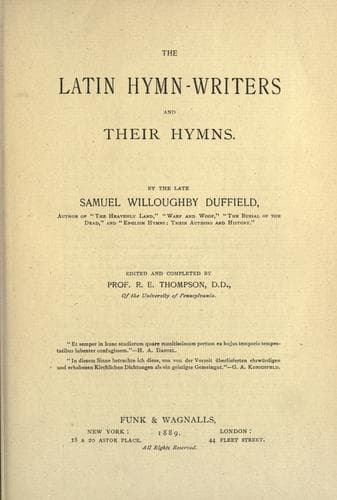
The Latin Hymn-writers and Their HymnsDuffield, Samuel Willoughby
Religion
The Latin Hymn-writers and Their Hymns
Duffield, Samuel Willoughby
Hymns, Latin -- History and criticism
In 822, when Egil died, by common consent Rabanus was invested with the
dignity of abbot. For a time things went smoothly enough, and such
scholars as Walafrid Strabo, Servatus Lupus, and Otfried of Weissenberg
were the glory of the Fulda schools. But the pendulum swung too far in
the rebound from Ratgar’s illiterate policy. The monks were kept at
writing and teaching with too little discrimination as to their tastes
and capacities. They began to grumble that the material interests of the
monastery were neglected, and that Fulda might be growing rich in books
and in bookworms, but was in danger of becoming poor in everything else.
The disaffection found a support in Archbishop Otgar of Mainz, a busy
political prelate, who seems to have become jealous of the prominence of
Rabanus. As a supporter of Lothar and of the policy of imperial unity,
he was in politics on the other side from Rabanus. Our abbot was a
Nationalist and a Home Ruler. He wished to foster the cultivation of the
German tongue and to maintain the distinctness of the German nation. He
had stood by poor, weak Ludwig the Pious, whose sorrow it was to have
succeeded to the work of Charles the Great. He addressed to him a letter
of consolation in his troubles, and wrote a treatise: _De Reverentia
Filiorum erga Patres et Subditorum erga Reges_, to recall his unfilial
children to a sense of their duty. In Ludwig the German he recognized
the most dutiful of the three. So when the Emperor Ludwig died in 840,
he supported the younger Ludwig in the demand for virtual German
independence against the high-handed imperialism of his elder brother
Lothar. He thus shared in the triumph of the victory at Fontanetum,
followed by the Compact of Verdun (843), which practically put an end to
Karling imperialism, and secured the national independence of France and
Germany. But in the mean time Otgar enabled the illiterate party at
Fulda to drive Rabanus into exile, and when he came back he found the
brethren had chosen another abbot, Hatto, in his stead. Waiving his own
rights, and laying aside all grudges, he betook himself to his books in
a priory or something of the sort on Mount St. Peter, not far off, and
resumed the work of teaching. Here he is thought to have composed his
great philosophical treatise on the All, which marks a distinct advance
in the development of mediaeval metaphysics and logic. Indeed, there was
but one thinker of the ninth century who surpassed him in penetration
and learning—the wonderful Irish monk, John Scotus Erigena, who wrote
Latin but thought in Greek and was filled with all the wisdom of the
Hellenes, from Plato to Dionysius the Areopagite.
Public-domain text, read in full here on John Shaqi.
Reviews
Reviews
No reviews yet
Be the first to share your thoughts on this work.
Elsewhere in the archive
Join the Discussion
Join the discussion
Sign in to leave a comment or review.
Sign InorCreate an account