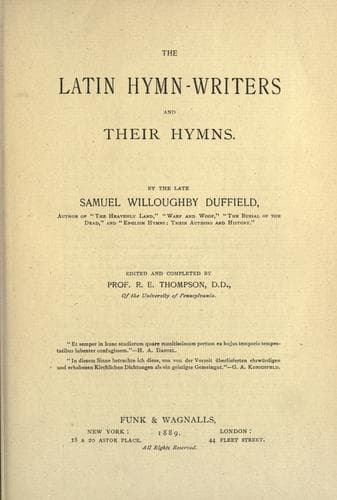
The Latin Hymn-writers and Their HymnsDuffield, Samuel Willoughby
Religion
The Latin Hymn-writers and Their Hymns
Duffield, Samuel Willoughby
Hymns, Latin -- History and criticism
In 847 Archbishop Otgar died, and Ludwig the German elevated his friend
Rabanus to the see of Mainz, the metropolitan see of Germany. Since
Boniface, the Anglo-Saxon “Apostle of Germany,” who had succeeded to
this dignity a century earlier, there had been no man of such eminence
at the head of the German Church, nor have any of his successors
surpassed him. His first care was the restoration of the discipline,
which had decayed under the confusions of those dark days of civil war.
A great synod met at Mainz in October, Rabanus having been consecrated
in June. Besides the prelates, abbots and monks of all orders attended,
and the canons adopted had reference to stricter life as the obligation
of the clergy.
The year was not over before news of fresh trouble reached him. One of
his own pupils at Fulda, the monk Gottschalk, a man of restless
intellect, was reported as spreading an exaggerated version of
Augustine’s doctrine of absolute predestination, and one which
threatened to overturn the very idea of human responsibility. Gottschalk
evidently was one of the people who love to walk on the fence rather
than in the road—to carry every principle with ruthless logic to its
remotest conclusion. The first news of his extravagances reached Rabanus
in a letter from Italy setting forth the doctrines his former pupil was
teaching. He at once responded in a letter (or rather a treatise) taking
the same ground as the semi-Pelagians had done in the controversy with
the school of Augustine, ground sanctioned by Gregory the Great, Beda,
and Alcuin, although thought unsafe when first defended by Gennadius and
John Cassian. Gottschalk seems to have accepted the reply as a sort of
challenge. The next year, 848, he made his way to Mainz, and when
Rabanus called together an assembly of churchmen and laymen—not a
regular synod—he appeared before it with a confession of his faith in
which he replied to the arguments of Rabanus. The assembly failed to
convince him of his being in error, and at the king’s suggestion a
pledge was exacted of him that he would never return to Germany. Hincmar
of Rheims, the metropolitan of the Church of France, made sure of his
keeping this pledge. As Gottschalk was handed over to him by King
Ludwig, with a letter of explanation from Rabanus, he had him condemned
by the Synod of Quiercy (853) to deposition from the priesthood,
corporal chastisement until he should burn his confession with his own
hands, and lifelong imprisonment. So ended, in 867, this Calvinist of
the ninth century, without much credit to anybody who had a hand in his
fate, but with least of discredit to Rabanus.
Public-domain text, read in full here on John Shaqi.
Reviews
Reviews
No reviews yet
Be the first to share your thoughts on this work.
Elsewhere in the archive
Join the Discussion
Join the discussion
Sign in to leave a comment or review.
Sign InorCreate an account