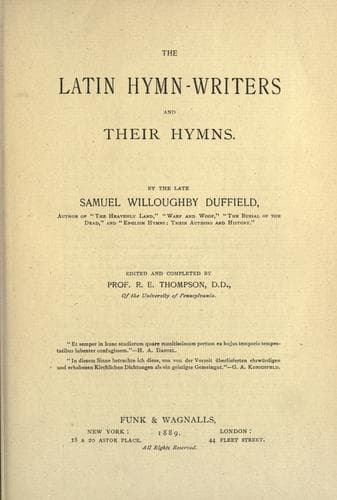
The Latin Hymn-writers and Their HymnsDuffield, Samuel Willoughby
Religion
The Latin Hymn-writers and Their Hymns
Duffield, Samuel Willoughby
Hymns, Latin -- History and criticism
In 852, by order of King Ludwig, another synod convened at Mainz, to
discuss, it is supposed, the doctrine of transubstantiation, which
Paschasius Radbertus of Corbie had been setting forth in his treatise,
_De Corpore et Sanguine Christi_. Our Rabanus resisted the new dogma,
declaring that the participation of the Lord’s body and blood in the
sacrament is “not carnal but spiritual.” Nor is this the only point of
his agreement with Protestant teaching. Especially in his assertion that
the Bible is a book for every Christian, and clear and intelligible as a
rule of faith, he anticipates Luther.
In 850 a great famine desolated Germany, in whose course people were
driven to the terrible deeds which sometimes characterize such times.
Rabanus did his possible to relieve the terrible needs of his flock.
Three hundred of these poor people were fed daily from his resources as
archbishop, and his heart went out in pity to the multitudes he could
not aid. Pitiful scenes he must have witnessed. One poor woman fell dead
as she staggered to his threshold, with a babe at her breast. His
charity was too late to save her, but her child was rescued.
He lived six years more, seeing his diocese recover from the desolation
of that terrible winter, cherishing the literary and educational work of
the monasteries on the lines laid down in his _De Institutione
Clericorum_, keeping his clergy up to the ideal of the priestly life as
defined in his _De Disciplina Ecclesiastica_, and civilizing the rude
people of his great diocese. He died in 856, in his eightieth year, and
was buried in St. Alban’s church in Mainz. In the era of the Reformation
his bones were transferred to St. Maurice’s church in Halle. As Rome has
not inscribed the opponent of transubstantiation in the list of her
saints, they are allowed to rest together in peace, instead of being
distributed through a long series of churches as relics.
He had composed for himself an epitaph, as was the fashion of those
days, but it is pleasanter to read than some of those exaggeratedly
humble and prosaic treatises concerning which we hardly know whether
most to stand amazed at the badness of the Latin or the meanness of the
piety. Rabanus avoids these objectionable features. His language is that
of a poet and his sentiments those of a sincere Christian. Particularly
there are two lines which are notable because they give us a glimpse of
his personality:
“Promptus erat animus, sed tardans debile corpus;
Feci quod poteram, quodque Deus dederat.”
“Quick was my mind, but slow was my body through weakness;
That which I could I have done, and what the Lord gave me.”
One of his latest bequests was that of his books, which he devised, like
a true scholar, partly to his old abbey of Fulda and partly to the
monastery of St. Alban at Mainz.
Public-domain text, read in full here on John Shaqi.
Reviews
Reviews
No reviews yet
Be the first to share your thoughts on this work.
Elsewhere in the archive
Join the Discussion
Join the discussion
Sign in to leave a comment or review.
Sign InorCreate an account