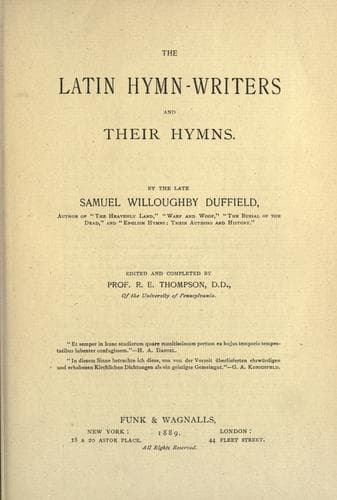
The Latin Hymn-writers and Their HymnsDuffield, Samuel Willoughby
Religion
The Latin Hymn-writers and Their Hymns
Duffield, Samuel Willoughby
Hymns, Latin -- History and criticism
John Trithemius eulogizes him in words which may, perhaps, be
transferred into our pages from their original Latin as a specimen of
the praise which Rabanus has always received—praise that is indeed
worthy of the man who wrote the _Veni, Creator_.
“Rabanus was first among the Germans; a scholar universally erudite;
profound in science; eloquent and strong in discourse; in life and
conversation he shone as most learned, religious, and holy; he was
always a prelate dignified, affable, and acceptable before God.”
This same Trithemius gives us a little notion of the bishop’s
appearance. In body, he says that he was tolerably robust; of a
sanguine, bilious temperament; rather fleshly in person than inclined to
meagreness (_macilentus_); with a “courageous and great” head; and of a
well-proportioned figure.
Of the other writings of Rabanus it is sufficient for us to name his
compendium of the grammar of Priscian; his great work upon _The
Universe_; his treatise upon the _Praises of the Holy Cross_, and his
elaborate commentaries upon the various books of the Bible. He also
prepared homilies and sundry compositions relative to ecclesiastical
matters. In the _Patrologia_ of Migne it requires six closely-printed
volumes to cover his contributions to sacred literature. Especially we
have occasion to note his theological writings, as it is in these that
his spiritual character is most apparent.
His works mostly are dead enough to modern interest, but not all. German
philology honors in him a great churchman who shared Charles the Great’s
respect for German speech and culture, and at whose feet Otto of
Weissenburg, the poet of the _Krist_, sat. German pedagogics recognizes
in him the first _Praeceptor Germaniae_, who transplanted to Fulda the
generous plans of education which Charles conceived, and which Alcuin
executed at Tours. German philosophy recognizes in him the first
forerunner of the great series of her metaphysicians. But to us he is
Rabanus the poet, who acquired the art of verse under Alcuin, who used
it at times to little purpose as in his _De Laudibus Sanctae Crucis_,
but who in a happy hour wrote the _Veni, Creator Spiritus_.
CHAPTER XIII.
NOTKER OF ST. GALL, CALLED BALBULUS.
Public-domain text, read in full here on John Shaqi.
Reviews
Reviews
No reviews yet
Be the first to share your thoughts on this work.
Elsewhere in the archive
Join the Discussion
Join the discussion
Sign in to leave a comment or review.
Sign InorCreate an account