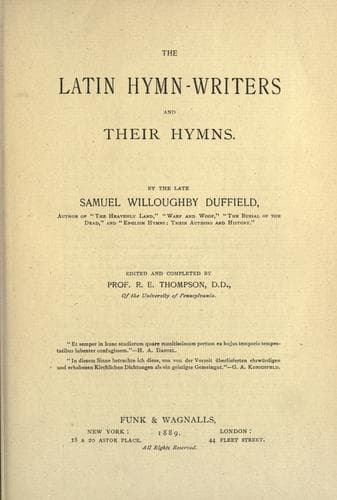
The Latin Hymn-writers and Their HymnsDuffield, Samuel Willoughby
Religion
The Latin Hymn-writers and Their Hymns
Duffield, Samuel Willoughby
Hymns, Latin -- History and criticism
In the life of Notker, written by Ekkehard (Eckhardt) the Younger, who
was Dean of St. Gall in 1220, we have a perfect mine of garrulous gossip
and of chattering, pleasant romance. It has been called “one of the most
delightful of mediaeval memoirs;” though we are very little disposed to
accept a large share of it as solid fact. There is in it much confusion,
both of dates and names. From one of its stories came the designation of
Charles the Great (“the Emperor Charles”) as the author of the _Veni
Creator_, a point which we have treated more fully in the chapter upon
Rabanus Maurus. The copyist is mainly accountable for these blunders,
some of which are so grossly anachronistic as to be at once corrected by
their reader; and others are so puerile that no one can easily be
deceived.
Since it is to Notker that we owe the “sequence” in its full
development, it may be as well for us to let Ekkehard sketch his
character at full length. The biography is in one of the April volumes
of the _Acta Sanctorum_ of the Bollandist Fathers—a great white-covered
folio which displays the immense research of its editors. For those who
are less inclined to the Latin language in its monkish form, there is
the admirable abridgment by Baring-Gould, known as the _Lives of the
Saints_—a compilation which must be always distinguished from the work
of the same title by Alban Butler. From these sources a great deal of
truth and falsehood, fact and fiction, real record and unreal romance,
have flowed forth upon the world. We cannot but speak reverently and
kindly of such noble endeavors as those of Dr. Neale, but here, at the
very outset, it must be understood that he has been altogether too much
swayed by peculiar opinions for his ideas upon sequences—and upon Notker
also—to have the weight of absolute authority.
Notker himself is to be discriminated from another Notker of the same
religious house of St. Gall, who is generally known as “the Physician.”
This one is Balbulus, or “the Stammerer,” who is sometimes called
“Vetustior,” the Elder, to distinguish him from his nephew, Notkerus
Junior. He came, Ekkehard asserts, of noble and even royal parentage,
being probably born about the year 850. At an early age he entered the
monastery of St. Gall, in Switzerland, which had been founded by Gallus,
the Irish saint, a disciple of Columbanus, in the seventh century. This
celebrated man died, A.D. 640, at the age of ninety-five, and his life
was written by Walafrid Strabo in two books; the martyrology recording
his death upon October 16th. St. Gall itself is now a town of some
fifteen thousand inhabitants, and the capital of the canton to which it
has given its own name. But the abbey was suppressed in 1805, though the
library, filled with valuable manuscripts, still remains. From these
ancient parchments P. Gall Morel, Librarian at Einsiedeln, has
resuscitated many sequences and hymns formerly employed in their
services.
Public-domain text, read in full here on John Shaqi.
Reviews
Reviews
No reviews yet
Be the first to share your thoughts on this work.
Elsewhere in the archive
Join the Discussion
Join the discussion
Sign in to leave a comment or review.
Sign InorCreate an account