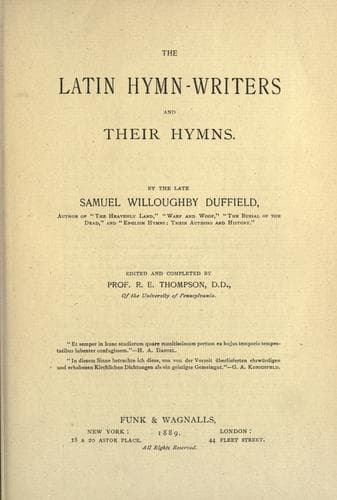
The Latin Hymn-writers and Their HymnsDuffield, Samuel Willoughby
Religion
The Latin Hymn-writers and Their Hymns
Duffield, Samuel Willoughby
Hymns, Latin -- History and criticism
It is perfectly plain, then, that this “third sequence”—the _Media vita_
being the second—is derived from the “verses” whose authorship Canisius
cannot discover, and the date of which cannot be far from the fourteenth
century.
But when we imagine the good monk watching the workmen from the brink of
the Goldach, which hurries down through St. Gall toward the Boden-See,
we can bring to mind the whole picture. The present bridge is one
hundred and sixteen feet long and fully one hundred in height from the
swift little stream. It is of wood, and was constructed in 1468. Here,
dizzily balancing in mid-air, tradition says that a man, even as Notker
gazed, lost his footing and plunged into the abyss. The eternities came
together! A spark from the infinite kindled within the poet’s soul.
Heaven from on high beheld this single life suddenly hurled to ruin.
Earth from beneath reached up and seized upon the thing of earth. And
thus it was with us every moment! In the midst of life we were in death,
and from none could we seek for help save from God alone—that God,
displeased at sinners, who is the sinner’s only hope!
Standing once before the graves at Gettysburg, the tall gaunt figure of
Abraham Lincoln paused upon such an eternal edge. His soul took in at
one sweep the heroic past and the historic future. And those words which
came, so men assure us, almost without premeditation from his lips are
the noblest utterance of our time. That compact, terse, brief expression
is the essence of national strength. The phrases are vivid with a
supernatural brightness: “Government of the people, for the people, by
the people must not perish from the earth.” It was so with Notker; and
now, wherever that beautiful service is uttered above the dead, the
forgotten monk of St. Gall speaks with a voice which touches unaltering
humanity, and utters that grave, great thought, preciously protected in
its small casket of language, that death is beneath and God is above,
and that all our hope must come from Him!
CHAPTER XIV.
WALAFRID STRABO.
Public-domain text, read in full here on John Shaqi.
Reviews
Reviews
No reviews yet
Be the first to share your thoughts on this work.
Elsewhere in the archive
Join the Discussion
Join the discussion
Sign in to leave a comment or review.
Sign InorCreate an account