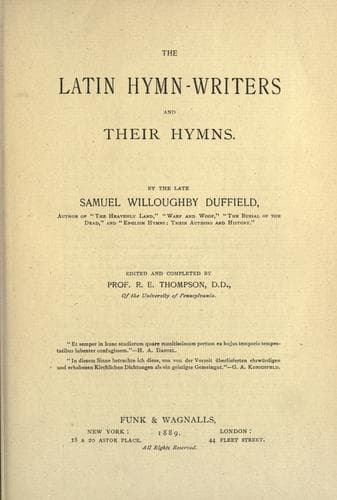
The Latin Hymn-writers and Their HymnsDuffield, Samuel Willoughby
Religion
The Latin Hymn-writers and Their Hymns
Duffield, Samuel Willoughby
Hymns, Latin -- History and criticism
Among the pupils of Rabanus Maurus was a boy afflicted with strabismus.
He was cross-eyed, or crooked-eyed in some manner, and this fixed upon
him the name of Strabo the “squinter.” Like many another monk in that
age, he has so sunk himself into his service as to have become a man
without a country and almost without parentage. Some therefore contend
that he was an Anglo-Saxon, once a monk in London and afterward educated
at St. Gall, Reichenau, and Fulda. An obscure tradition even makes him a
relative of the Venerable Bede. Another story assigns him to Haymo’s
family. Now, Haymo was a monk of Fulda about 850, a man of very liberal
opinions, learned, and truly catholic, especially in his denial of the
universal authority of the Pope and the doctrine of transubstantiation.
It is something of an honor to have been this man’s brother, and it is
no discredit to have been related to Bede. At any rate these guesses—for
they are little else—serve to show us the repute in which Walafrid
Strabo was held.
More accurate investigation reveals a sentence in the preface to the
life of St. Gall which seems conclusive. In it Walafrid speaks of “us
Germans or Suabians.” Suabia is thus designated as his birthplace, and
we find his name among the list of those scholars who did credit to
their teacher Rabanus.
His period is the middle of the ninth century, for in 842 he became
Abbot of Reichenau in the diocese of Constance, and he died in 849.
Dates like these are not hard to verify, for we have many chronicles and
records in which the Dark Ages laid the foundations of authentic
history. Here lie away in their narrow niches of brief reference many
illustrious people. And the work of the hymnologist consists often
enough in the same sort of research as secular history demands. Now and
then on the dead breast there is a little withered flower ready to
crumble into dust.
That curious, peering Trithemius—to whom we are indebted for such
laborious inquiries concerning the men of this time—maintains that
Walafrid was “rector” of the school in the monastery of Hirschfeld. If
this be so it only confirms what we note again and again, that Alcuin
and Rabanus were the real instigators of German scholarship. And the
work from which we shall presently quote becomes more interesting to us
for this reason.
Public-domain text, read in full here on John Shaqi.
Reviews
Reviews
No reviews yet
Be the first to share your thoughts on this work.
Elsewhere in the archive
Join the Discussion
Join the discussion
Sign in to leave a comment or review.
Sign InorCreate an account