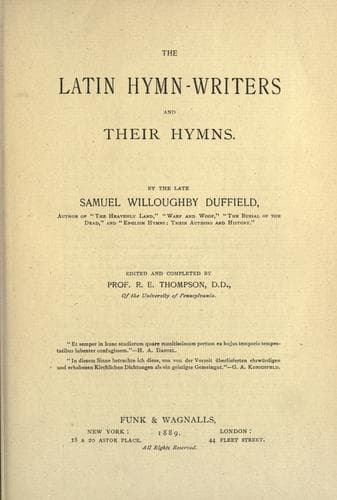
The Latin Hymn-writers and Their HymnsDuffield, Samuel Willoughby
Religion
The Latin Hymn-writers and Their Hymns
Duffield, Samuel Willoughby
Hymns, Latin -- History and criticism
Walafrid left a long catalogue of works behind him. He wrote a valuable
antiquarian treatise on the divine offices and usages of the Church.
Besides, he is accredited as the author of the lives of St. Gall, St.
Othmar, St. Blaithmac, St. Mamma, and St. Leudegaris. He also composed
various poems; a preface to the Life of Ludwig the Pious, and a
condensation of Rabanus Maurus’s Commentary on Leviticus. He compiled
the famous _Glossa Ordinaria_, which remained the standard commentary on
the Bible throughout the Middle Ages. He began the annals of Fulda,
which have since been continued by competent hands, notably those of
Christopher Brower. He has been called a “pretty good poet for his
age”—by which is meant that there was a scanty supply of poetry in the
ninth century—a fact which no one is competent to dispute.
It goes without saying that his life was the life of an ecclesiast,
restricted to a Chinese minuteness of ritual, and permitting only such
visits and journeys as religious business justified. His death occurred
on one of these infrequent expeditions. It was in France, whither he had
gone—as we are expressly told—in order to hasten some ecclesiastical
affair.
These are the meagre and unentertaining facts connected with the name of
Walafrid Strabo. He would not have deserved, nor would he have received
our notice if two of his hymns (the _Laudem beatae martyris_ and the
_Gloriam nato cecinere_) had not been preserved. These entitle him to
mention, and he promptly rises to genuine importance if we can agree
with Kellner (see _Bibliotheca Sacra_, January, 1883, p. 154), that a
recently discovered “diary” is from his pen. It is probable that,
whether it be authentic or not, it is strictly accurate in its relation
of the studies pursued in those schools. And if we assume it to be
credible we can revise our dates to correspond.
Thus his school life began in 816, and after its close he went to Fulda,
thence to return to his old monastery in 842 as its abbot. These dates
are afforded by the document itself, which was originally published in
1857, as a part of the educational report of the Benedictine school of
St. Maria of Einsiedeln in Switzerland. It appears to me that its tone
and composition are not such as to justify the value which Kellner sets
upon it. Walafrid’s name was a convenient one, and this is doubtless no
more nor less than a clever historical romance. But it has been composed
in the very neighborhood of the scenes it depicts, and the advantages of
all the ancient MSS. and traditions have been incalculably great.
The narrative is introduced by a modern preface which speaks of St.
Meinrad, the founder of Einsiedeln, as a contemporary of Walafrid. Then
we have a statement which tersely exhibits the plan and purpose of the
story:
Public-domain text, read in full here on John Shaqi.
Reviews
Reviews
No reviews yet
Be the first to share your thoughts on this work.
Elsewhere in the archive
Join the Discussion
Join the discussion
Sign in to leave a comment or review.
Sign InorCreate an account