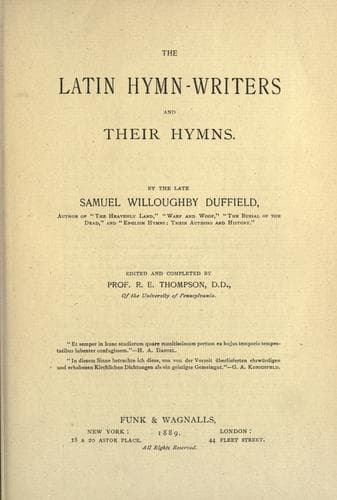
The Latin Hymn-writers and Their HymnsDuffield, Samuel Willoughby
Religion
The Latin Hymn-writers and Their Hymns
Duffield, Samuel Willoughby
Hymns, Latin -- History and criticism
“In the dark hour when the Roman imperial throne collapsed on which
Theodoric the Goth had just seated his teacher Avitus, Manlius Boethius
committed his spiritual wealth to the Goth Cassiodorus, who transmitted
it to the sons of St. Benedict,” etc.
“The seed of Christian instruction had been inherited by the sons of St.
Benedict from the age of martyrs and holy fathers. Great seminaries were
opened at Fulda, Weissenberg in the bishopric of Speyer, St. Alban in
Mainz, St. Gall, Reichenau in the bishopric of Constance, St. Maximin,
and St. Matthias in Trier, etc. To these establishments the sons of the
nobility resorted, while the Benedictines were their teachers and
fathers. Whoever saw one of these schools saw them all as to everything
essential. Accordingly, it is our purpose to describe one of
them—namely, the school of Reichenau, from which came the founder of
Einsiedeln, St. Meinrad, and Walafrid Strabo, who was his schoolmate in
Reichenau, and who, four years after him, assumed the Benedictine
dress.”
Then follows an assurance to the “intelligent reader” that this account
“is not mere poetry,” but is “sustained by authoritative documents,”
among which are named the writings of Walafrid himself, of Bede, Alcuin,
Rabanus, and the collections of Pez, Metzler, and others. It is plain,
then, that Kellner has been misled, and that Professor J. D. Butler, of
Madison, Wis., who has made this clever translation from the German, has
been likewise deceived. Yet the historical importance of the “diary”
remains, and the writings of Alcuin, Bede, and Rabanus, with those of
Walafrid, give the original particulars and can be cited in proof.
Professor Butler adds a few pleasant details about Reichenau. It was
founded in 724, earlier than any neighboring convent except St. Gall. It
is on an island in the Lake of Constance, whose lake-girt limits are
about two miles by three. It became so rich that it acquired many other
properties, and its abbot could journey to Rome and never sleep a night
outside of his own domain. The old tower, built by Henry the Black, is
still standing, and among the cherished relics of the abbey is a piece
of green glass weighing twenty-eight pounds given by Charlemagne, who
thought it to be an emerald. There is also a supposititious water-pot
from Cana of Galilee, which evidently came from Palestine and shows the
mediaeval intercourse with the Holy Land. The revenues of the abbey were
not sequestrated until the year 1799. Such is a brief sketch of this
religious house which we shall again encounter in the story of Hermannus
Contractus.
Public-domain text, read in full here on John Shaqi.
Reviews
Reviews
No reviews yet
Be the first to share your thoughts on this work.
Elsewhere in the archive
Join the Discussion
Join the discussion
Sign in to leave a comment or review.
Sign InorCreate an account