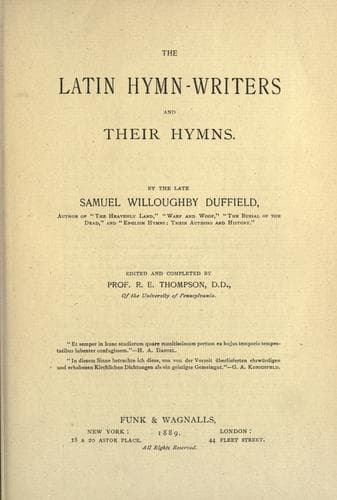
The Latin Hymn-writers and Their HymnsDuffield, Samuel Willoughby
Religion
The Latin Hymn-writers and Their Hymns
Duffield, Samuel Willoughby
Hymns, Latin -- History and criticism
It does not, of course, absolutely follow that these are really such
fragments of hymns as scholars have supposed. The late Dr. Lyman
Coleman—a man of great practical good judgment—comments upon these
citations thus:
“The argument is not conclusive; and all the learned criticism, the
talent, and the taste, that have been employed on this point, leave us
little else than uncertain conjecture on which to build an hypothesis.”
(_Primitive Church_, p. 366.) Yet the latest scholarship tends so
strongly in this direction, and the internal evidence is so good and
fair, that it may be regarded as pretty well affirmed and accepted. No
one, for example, would think of comparing such passages as these with
the antithetic prose of Romans 3:21-23; or with the magnificent
unrhythmic utterance in Romans 8:38, 39; or with the careful
particularity of 2 Corinthians 6:4-10. They are seen and felt to be
different both in tone and in form.
In the Apocalypse, where the language is naturally exalted and poetic,
several such instances have been noted. They are: Revelation 1:4-8; 5:9,
10, 12-14; 11:15, 17, 18; 15:3, 4; 21:10-14, and 22:17. Of one of
these—the “Song of Moses and of the Lamb”—we may be reasonably certain:
“Great are Thy works and strange,
Lord God, Thou Ruler of all!
And just are Thy ways, and true,
Thou King of the nations of earth.
For who shall not fear Thee, Lord,
And give to Thy name the praise,
For holy art Thou alone!—
To Thee shall the nations come
And worship before Thy face;
For all of Thy righteous acts
Shall then be openly known!”
In the same manner may be written the stanza from Revelation 22:17:
“And the Spirit and the Bride—
Are saying, ‘Come!’
And he that heareth—
Let him say, ‘Come!’
And he that thirsteth—
Let him come!
And he that willeth—
Let him receive,
Freely, the water of life!”
We have also a positive acquaintance with the order of religious worship
in the early Church, dating back one hardly knows how far, but
definitely leading us into the custom of the first three centuries.
Public services began, and were continued, as follows:
First, _Prayer_—or, possibly, a _Salutation_ or _Invocation_, such as is
in common use to-day.
Then the _Reading of Scripture_. The Old Testament and New Testament
were both employed: the one being expounded to apply to the case of the
Christian Church; and the other for her comfort, encouragement, and
edification.
Public-domain text, read in full here on John Shaqi.
Reviews
Reviews
No reviews yet
Be the first to share your thoughts on this work.
Join the Discussion
Join the discussion
Sign in to leave a comment or review.
Sign InorCreate an account