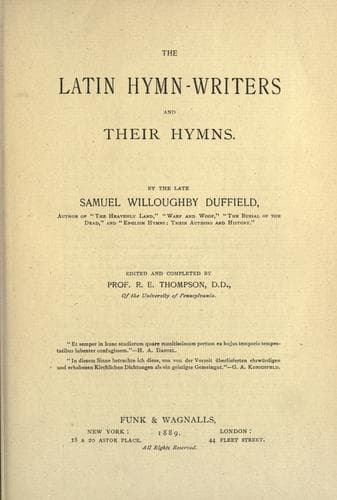
The Latin Hymn-writers and Their HymnsDuffield, Samuel Willoughby
Religion
The Latin Hymn-writers and Their Hymns
Duffield, Samuel Willoughby
Hymns, Latin -- History and criticism
Then followed the _Hymns_ and _Psalms_. The distinction appears to have
been that the _psalms_ were those of David; the _hymns_, such as the
song of Mary, or of the angels; and the _spiritual songs_, such as were
composed by private persons, or which sprang up spontaneously in a kind
of chant. That this was liable to abuse, and might cause confusion, is
made evident by Paul’s advice to the Corinthians. Between these acts of
praise was interpolated some brief Scripture lesson. And, very likely, a
considerable portion of time was taken up by this part of the service.
Then came the _Sermon_, which was succeeded by a _Prayer_.
Another question now meets us, and one of some importance: Did the early
Christians employ any musical instruments? In reply, it can be noted
that ψάλλειν, “to make melody” (Eph.5:19), is usually taken to refer to
a musical accompaniment. In Romans 15:9 it is a quotation from Psalm
18:50, where it means, “I will _sing psalms_.” In 1 Corinthians 15:15
(“I will _sing_ with the spirit, and I will _sing_ with the
understanding also”) and in James 5:13 (“Is any merry? let him _sing
psalms_”) we have nothing decisive except that we know that the Jewish
method of “singing psalms” was to the accompaniment of musical
instruments. Thus, with all these texts before us, we are not able
either to affirm or deny the fact. The reference of Paul (1 Cor. 14:7)
to the _pipe_ (αυλός, flute) and _harp_ (κιθάρα, lute) gives us no
assistance. The “harp” of Revelation 5:8, 14:2, and 15:2, is the cithara
or _lute_ again; but neither does this tell us what the early Christians
did or did not do. The inference is pretty strong that they avoided some
things that were Jewish—and instrumental music was a marked feature in
the Jew’s worship—but it is plain that (as with the Sabbath question)
there was a great deal of blending at the edges between the two
dispensations. We are told, moreover, that the Syriac Church has always
been rich in tunes, having fully two hundred and seventy-five, while the
Greek was confined to about eight.
There is another fact which comes in just here, however, to explain what
we would otherwise find it hard to unriddle. It is the matter of the
very language of the hymns themselves.
Public-domain text, read in full here on John Shaqi.
Reviews
Reviews
No reviews yet
Be the first to share your thoughts on this work.
Join the Discussion
Join the discussion
Sign in to leave a comment or review.
Sign InorCreate an account