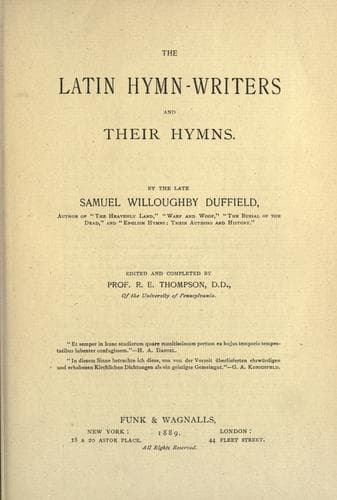
The Latin Hymn-writers and Their HymnsDuffield, Samuel Willoughby
Religion
The Latin Hymn-writers and Their Hymns
Duffield, Samuel Willoughby
Hymns, Latin -- History and criticism
Walafrid’s narrative begins with the year 815. He saw the vast buildings
with surprise and was greeted by a throng of future schoolmates. His
teacher had several boys under his care to teach them to read. This he
did by the help of a wax tablet—the old Roman method. The letters were
scratched on the wax and erased by the blunt end of the pointed “style.”
Along with this elementary work came Latin, together with a German
primer—in both of which the boys were expected to read.
At harvest time there was a short vacation. The boys rambled through the
fields and picked fruit and enjoyed themselves generally.
The second year’s work was the learning of conversational Latin. This
was the language of daily intercourse and was employed to express all
wants. The grammar of Donatus was studied under a pupil-teacher, and the
cases and tenses were rigidly committed to memory. The rod was the
penalty for misbehavior. German phrases were translated into Latin and
some portion of biblical history was repeated to the scholars at night,
which they were obliged to tell again in the morning.
Then follows a description of the dedication of the minster and of the
solemn effect of the great High Mass, at which time Walafrid resolves to
become a monk.
The year 817 was occupied with grammar and orthography, and the use of
Latin was compulsory. Hitherto there had been a trifle of laxity and a
few lapses into German were forgiven. Now there was no exception to
scholars of this advancement. They wrote from dictation upon their
tablets, and the Psalter was in this manner transcribed and memorized.
The fourth year (818) was signalized by the planting of the first
grape-vine on the island. Doubtless the fact itself is authentic, and is
here introduced owing to its date. And in this year the scholars attack
prosody. They study Alcuin (who wrote many verses), and the distichs of
Cato, and Bede’s _De Arte Metrica_. The earlier Christian poets—Prosper
and Juvencus and Sedulius—are mentioned. It is strange that the author
does not name Prudentius, who was far more of a classic than any or all
of these three. But it is quite correct to mention Virgil as a permitted
book, and the exercises in poetry in which all were engaged.
In 819, the fifth year, the boys became pupil-teachers themselves. They
were further instructed in rhetoric, with illustrations from the Bible
to be paralleled from Statius and Lucan, whose works they were studying.
Other scholars again were set to work as scribes and copyists. The
amusements were the running of foot-races, quarter-staff playing, and
“dice,” by which we are probably to understand the very ancient game of
backgammon. And again, it is strange that no mention is made of the
games of ball, which were decidedly common in those days.
Public-domain text, read in full here on John Shaqi.
Reviews
Reviews
No reviews yet
Be the first to share your thoughts on this work.
Elsewhere in the archive
Join the Discussion
Join the discussion
Sign in to leave a comment or review.
Sign InorCreate an account