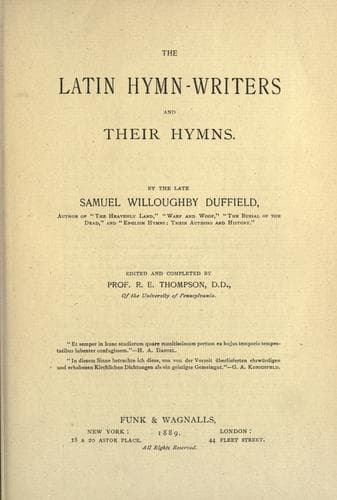
The Latin Hymn-writers and Their HymnsDuffield, Samuel Willoughby
Religion
The Latin Hymn-writers and Their Hymns
Duffield, Samuel Willoughby
Hymns, Latin -- History and criticism
The year 820 is consumed with rhetoric—with Cicero, Quintilian, and the
histories of Bede, Eusebius, Jerome, and others. The classic authors
were Sallust and Livy, with Virgil and (at last) Prudentius and
Fortunatus.
In 821 comes Boethius, attended by more of Cassiodorus, and the pleasant
pastime of “dialectics,” or debating. In these debates the enthusiasm
was kindled for future controversies. And in other lines—as, for
example, in studies of the current legal codes, of the Salic and
Ripuarian Franks and Lombards—those who were to be rulers were
diligently trained. Here (for this is the exact account of that ancient
instruction) we see how the Church held sway over her former pupils, and
how the pupils became by and by the exponents of religious opinions and
subservient to ecclesiastical decrees.
With 822 we have mention of rhetoric and logic, with oral and written
exercises, and in 823 the scholars took up and pursued the studies of
geometry and geography according to the light of that period. Then came
music with the various instruments, as organ, harp, flute, or trombone.
Finally, Walafrid is supposed to record his initiation into the reading
of Greek. From the MS. of Homer the boys were instructed, and the
account closes abruptly with a reference to the study of astronomy.
Subsequent to this year, 825, Walafrid is believed to have passed
considerable time at Fulda with Rabanus Maurus.
These were the ideas and educational methods of that period. Outside of
the monasteries and abbeys there was nothing that went on in the way of
learning. It needed special establishments, with great wealth, the
protection of kings and nobles, and the indefinable terrors of religious
authority to perpetuate scholarship. We may despise, as some writers
freely do despise, the bigotry and intolerance which obliterated fine
manuscripts of the classics to make room for monkish trifles. But we
cannot fail to discover the germs of the new poetry of the Church in
these unpromising times. Fortunatus and Prudentius were no bad
preceptors after all. And even if Walafrid Strabo was not much of a
poet, he has served our occasion as a pupil when he might not have
gained notice as a writer of hymns.
CHAPTER XV.
HERMANNUS CONTRACTUS AND THE “VENI SANCTE SPIRITUS.”
One of the surprises of history is the long-delayed honor which comes to
the modest and the meek. The notable and prominent attract to themselves
much of the repute of any age. They even gain the credit of achievements
to which they never put a finger. But by and by the “whirligig of time
brings in his revenges,” and they that were last become first.
Public-domain text, read in full here on John Shaqi.
Reviews
Reviews
No reviews yet
Be the first to share your thoughts on this work.
Elsewhere in the archive
Join the Discussion
Join the discussion
Sign in to leave a comment or review.
Sign InorCreate an account