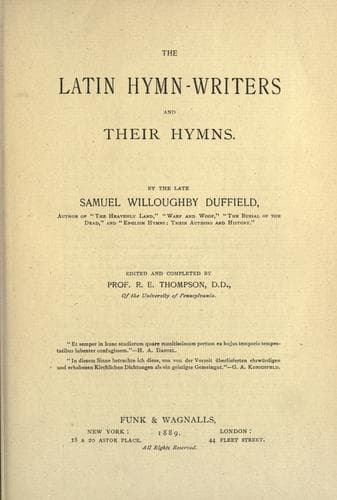
The Latin Hymn-writers and Their HymnsDuffield, Samuel Willoughby
Religion
The Latin Hymn-writers and Their Hymns
Duffield, Samuel Willoughby
Hymns, Latin -- History and criticism
Thoughts like these are sure to come to us when we encounter such a name
as this of the poor cripple of Reichenau. Whatever fame he had in his
own day gradually disappeared and he has been only a shadowy figure for
many years. It is true that Ersch and Gruber, in their great
encyclopaedia, say of him that he is “one of the most meritorious men of
the eleventh century.” It is also true that Ussermann—himself an almost
forgotten authority—has labored to give Hermann his proper meed of
praise; and that the Benedictines have patiently collated many little
particulars concerning him. Yet he still remains locked up in Latin or
in German or in French; and English readers can be pardoned for being
utterly ignorant of him and of his works.
This man merits no small share of our notice. He came of good blood, for
his father was the Count of Vöhringen in Suabia. He traced his kinship
to the famous St. Udalric, whose sister, named Leutgarde, is mentioned
(971) in the saintly bishop’s pages. Her son was Reginbald, slain in
battle against the Hungarians in 955. This Reginbald had a daughter
Bertha, who married Wolfrad, Count of Vöhringen, and died in 1032.
Wolfrad, dying in 1010, had a son Wolfrad, who married a lady named
Hiltrude and became the father of fifteen children—one of whom was
Hermann. This is the simplest form of a genealogy, which the learned
chronicler protracts in a marvellous manner, to the great confusion of
the modern mind. I have not cared to follow him into the remoter
affinities and alliances which add distinction to the poor little
paralytic child, who at seven years of age was carried to the great
school at St. Gall.
I have said that Hermann was a cripple. He was so completely helpless,
indeed, that he could not move without assistance; and his days and
nights were full of pain. He was “hump-backed and bow-breasted, crippled
and lame.” (_Gibosus ante et retro, et contractus, claudus_. Pertz:
_Monumenta: Scriptores:_ V., 268.) But his mind triumphed over these
infirmities. A pathetic legend concerning him assures us that in the
visions of the night the Virgin stood before him, radiant and beautiful.
As in the old story about the choice of Hercules—which was probably the
origin of this—she offers him strength of body combined with ignorance
and weakness of mind; or wisdom and ability in a body which should be
deficient and sickly to the day of his death. This “second Hercules”—as
the chronicler admiringly calls him—promptly chose the last.
Public-domain text, read in full here on John Shaqi.
Reviews
Reviews
No reviews yet
Be the first to share your thoughts on this work.
Elsewhere in the archive
Join the Discussion
Join the discussion
Sign in to leave a comment or review.
Sign InorCreate an account