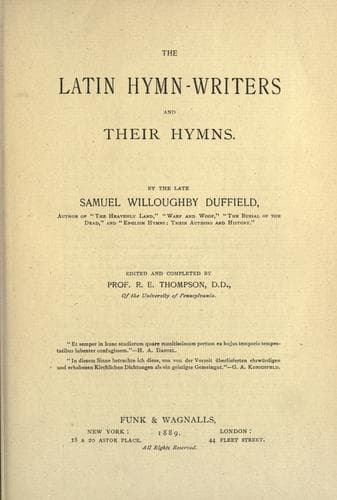
The Latin Hymn-writers and Their HymnsDuffield, Samuel Willoughby
Religion
The Latin Hymn-writers and Their Hymns
Duffield, Samuel Willoughby
Hymns, Latin -- History and criticism
He had been born (for his ancestral records and his own _Chronicon_ help
us to exactness) on July 18th, 1013. He was admitted to school,
probably, though not certainly, at St. Gall, on September 15th, 1020.
Hitherto his education had been absolutely neglected. He could not go
about alone nor even speak intelligibly (_Annales Augustani_ [1042-55].
In Pertz: _Mon. Ger._, VII., 126) owing to his paralysis. But he had a
devouring desire for knowledge, and rapidly mastered Latin, Greek,
Arabic, and (probably) Hebrew, so that he possessed them equally well
with his vernacular speech. The convent was the only place for such a
poor little waif as he, and thus, within the learned cloisters of St.
Gall, he followed reverently upon the shining path of Notker and Tutilo
and Ratpert and Hartmann, and added his name to theirs in the
development of the sequences and antiphons of the Church.
Nor was this all. He became an excellent historian, a distinguished
musician, and a renowned philosopher and theologian. In mathematics he
was equally skilled and ingenious. He is considered by some to have
invented the astrolabe, the first instrument by which the height and
distances of stars were calculated. Assuredly he wrote an exhaustive
treatise upon its use, whether he originated it or not; and it is said
that he added to his scientific studies the making of clocks and
watches. He has left us essays upon the monochord, on the squaring of
the circle, on computation and physiognomy and metrical rules and
astronomy. These are marked by the inferior attainments of the age, as
we might expect, but they display an amount of original research for
which we are unprepared.
He was also an excellent scribe, and the library of St. Gall still
contains a copy of a work ascribed to Anselm of Canterbury written by
him in the fulfilment of a vow. He resembled the Venerable Bede in the
universality of his knowledge, and, like Alcuin and Rabanus Maurus, he
is one of the great teachers of his time. Always, during these darkening
years, there appears to have been some ministering priest in the temple
of education—some self-devoted, God-fearing man, who patiently kept the
altar-fire burning, and spent his life, to the utmost verge, in climbing
those altar-steps with fresh fuel for the flame.
We do not know how much of this work was begun or completed during his
life at St. Gall. We are able to say that he translated Aristotle’s
Poetics and Rhetoric from the Arabic language, and this of itself should
award to him the very highest renown. It is impossible in a single
sentence to do justice to this achievement and we must take it more at
large.
Public-domain text, read in full here on John Shaqi.
Reviews
Reviews
No reviews yet
Be the first to share your thoughts on this work.
Elsewhere in the archive
Join the Discussion
Join the discussion
Sign in to leave a comment or review.
Sign InorCreate an account