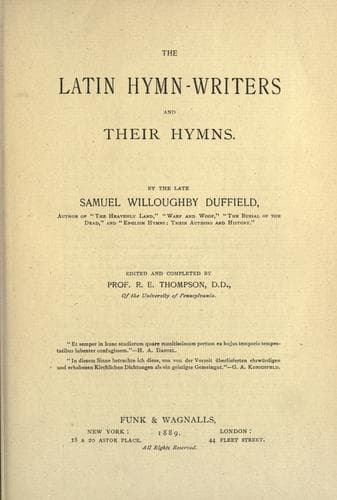
The Latin Hymn-writers and Their HymnsDuffield, Samuel Willoughby
Religion
The Latin Hymn-writers and Their Hymns
Duffield, Samuel Willoughby
Hymns, Latin -- History and criticism
The dictator Sylla brought the works of the great Greek philosopher,
together with his library, to Rome, in the year B.C. 147. This was on
the capture of Athens, and these writings were still comparatively
unknown in Greece. The philosophy of the Peripatetic school was, of
course, familiar to their countrymen; but it was by and through the
Latin race and not the Greek, that the “Master of Syllogisms” was to
become most potent. Aristotle’s was the controlling system of the Middle
Ages. His rules of logic were imperative. They governed theology, and
indeed every other form of metaphysics. They restrained with an iron
grip the expanding ideas of men. It was against Aristotle, in the person
of William of Champeaux, future Bishop of Chalons and founder of the
school of St. Victor, that Peter Abelard laid his lance in rest. Even to
the days of Dean Swift these ideas bore sway, and when that brilliant
man sought his degree from Trinity College, Dublin, he was met by the
question whether he reasoned according to Aristotle. And his reply, that
he did well enough in his own fashion, was held to be little less than
atheism. Nor is this the only comparison which might be aptly instituted
between Swift and Abelard.
So Aristotle had his authority and held his sceptre down almost to our
own time. But at the commencement his writings were either used in the
Greek language or in the Arabic. In the twelfth century the schools of
the Moors in Spain were the true centre of philosophy. They first
applied his teachings to theology, and to these schools resorted many
scholars from other parts of the continent. But such translations as
these travelling students brought home were probably of a sort to make
intricacy and subtlety more intricate and subtle. A fog had gathered
over Europe, and the Dark Ages are indeed no myth. There were few points
of light anywhere, and among these few were the bright spots called St.
Gall and Reichenau.
Public-domain text, read in full here on John Shaqi.
Reviews
Reviews
No reviews yet
Be the first to share your thoughts on this work.
Elsewhere in the archive
Join the Discussion
Join the discussion
Sign in to leave a comment or review.
Sign InorCreate an account