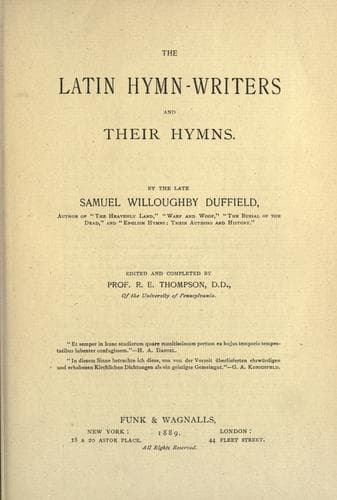
The Latin Hymn-writers and Their HymnsDuffield, Samuel Willoughby
Religion
The Latin Hymn-writers and Their Hymns
Duffield, Samuel Willoughby
Hymns, Latin -- History and criticism
Charles Jourdain asserts that only a part of Aristotle was known before
1200 A.D., and that this was through the translation of Boethius. (See
Ueberweg: Hist. Philos., I., 367.) So that if Hermannus Contractus
translated Aristotle at so early a date, it shows that his rendering was
in advance of most, if not of nearly all those which were used in the
Western schools. He had a brother, or uncle, Manegold, who died in
Palestine. He had another brother Werner, who afterward became a legate
to Gregory VII. (Hildebrand) in the fierce struggle between Pope and
Emperor in 1077. And he was further well placed both by his family
connections and his situation at a centre of learning, to secure the
best manuscripts and the best Arabic instruction. (See an elaborate
dissertation in Wegelin: _Thes. Rerum Suevicarum_, II., p. 120.) It
evinces decided wisdom and toil on his part to have undertaken and
completed this translation; and there is no doubt that the humble
paralytic from his bed of suffering influenced materially the scholastic
movements of the coming centuries. Could he have seen the swarming
thousands who built the abbey of the Paraclete; could he have witnessed
in vision the uprising of such schools as St. Victor in France and
Oxford in England; could he have heard Roger Bacon confess his
indebtedness to those pages; could he have foreseen the infinite
consequences both to the preservation and the hindrance of human
thought, with what strange zeal he would have traced each painful line!
But he could not know it. He had removed at thirty years of age to his
perpetual celibacy at Reichenau—Augia the Rich, as it is called in the
Latin tongue. It is built on an island in the western arm of the Lake of
Constance. And there, with great mountains to gaze upon and fair waters
to catch for him the rosy light of evening; with the brethren of the
convent laboring cheerfully in their fields or toiling in their cells,
Hermann of Vöhringen, Hermann of Reichenau, Hermannus Contractus,
Hermann der Gebrechliche, Hermann the Cripple, spent his uneventful
life.
Public-domain text, read in full here on John Shaqi.
Reviews
Reviews
No reviews yet
Be the first to share your thoughts on this work.
Elsewhere in the archive
Join the Discussion
Join the discussion
Sign in to leave a comment or review.
Sign InorCreate an account