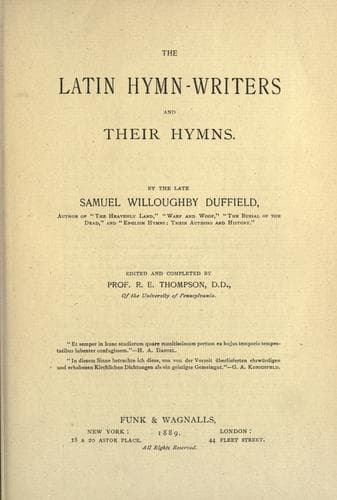
The Latin Hymn-writers and Their HymnsDuffield, Samuel Willoughby
Religion
The Latin Hymn-writers and Their Hymns
Duffield, Samuel Willoughby
Hymns, Latin -- History and criticism
It is a curious question this. It is only another proof of the neglect
into which a great man has fallen. For Hermann is called “nostri
_miraculum_ seculi” by the next generation who came after him. And there
is no _absolute_ proof that, “without lexicon or grammar” (for so
Jourdain puts it), he could not have mastered Arabic. Observing the
topics of his other writings cognate to those of Aristotle, I am
therefore not in the least inclined to yield to even M. Charles
Jourdain.
CHAPTER XVI.
PETER DAMIANI, CARDINAL AND FLAGELLANT.
It is not every poet who begins by keeping the swine and ends by wearing
the red hat and purple robe of a cardinal-bishop. Nor is it every poet
who commences as a forlorn and deserted foundling, to whom it is a great
mercy to have even swine to keep by way of getting his daily bread. But
all this and more befell Damiani.
We are not informed about his parentage, except that he had a mother who
abandoned him, and a brother (or, more probably, an uncle) who took pity
on him. He was born in Ravenna. Some authorities say it was in 988;
others that it was in 1007. A modern hymnologist, anxious to be right
(though he is frequently wrong), sets it at 1002. But 1007 has the
greatest weight of evidence.
This brother, or uncle, had compassion on the lad, and poor little
outcast Peter was sent by him “into his fields to feed swine,” a much
more honorable employment of course in Italy than in Palestine, and one
which he shared with Nicholas Brakespeare, the English pope, Hadrian IV.
What was his previous history we cannot discover, though the _Acta
Sanctorum_ for February 23d is full of legendary accounts. We only know
that his natural abilities attracted the notice of another relative
(brother, some say), who was an archdeacon at Ravenna. He it was who
advanced Peter to the opportunities of education, and who proved so fast
a friend that the boy took his patron’s name for his own. As Eusebius
called himself Eusebius Pamphili (Pamphilus’s Eusebius), so Peter became
Peter Damiani, “Damian’s Peter,” and this designation has adhered to him
ever since. It is amusing to read now and then of _Peter Damianus_, as
if Damiani were an Italian nominative case instead of a Latin genitive.
His birth was too obscure to lead any person to interfere with him. He
therefore quietly studied and improved, to the edification of his
fellow-pupils and the admiration of his teachers. His school-training
was, first of all, in Faenza. Thence he was sent to Parma, and
eventually he returned to Ravenna, where he taught with distinction and
popular approval, until he was nearly or quite thirty years old.
Public-domain text, read in full here on John Shaqi.
Reviews
Reviews
No reviews yet
Be the first to share your thoughts on this work.
Elsewhere in the archive
Join the Discussion
Join the discussion
Sign in to leave a comment or review.
Sign InorCreate an account