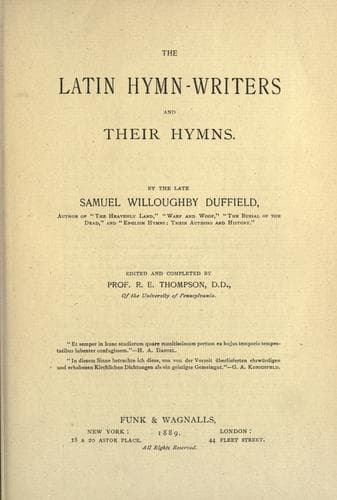
The Latin Hymn-writers and Their HymnsDuffield, Samuel Willoughby
Religion
The Latin Hymn-writers and Their Hymns
Duffield, Samuel Willoughby
Hymns, Latin -- History and criticism
The age was barbarous and good professors were scarce. It seems to have
been expected that brilliant minds would go on shining like those
exhaustless lamps which are fabled to have been found in the tombs of
the old magicians. If such was the case, with the intense intellect of
Damiani he must have tapped some source of real spiritual power early in
his course, for he burns brightly even now as we read his vivid
truthfulness and peruse some of his lovely verses, out from which leap,
nevertheless, tongues of flaming scorn for hypocrites and simonists.
Yes, the age was barbarous, and therefore Peter Damiani was soon a
professor, with many students and an abundance of fees. Knowledge in
those days not only meant power but wealth, and he was fast growing rich
in Ravenna. It was a delightful life, but it did not suit him. He was,
in fact, the “spiritual kinsman, and in many respects the pioneer” of
Gregory VII. Hildebrand came to be, after awhile, his personal friend,
his _sanctus Sathanas_, his Mephistopheles, his instigator and
stimulant. Of a sudden, then, he departed from Ravenna to take up his
abode with the hermits of Fonte Avellana, near Gubbio. Here he was known
by the name of Frater Honestus, and surely he deserved the title, for he
was a swift witness against every sort of sin. Guy, the abbot, persuaded
him to undertake the instruction of the brethren, and thus he found
himself back at his old work of teaching once more.
It was not long before the new monk became prior of the convent. Then,
in 1041, he rose to be abbot. And then, in 1047, he indited to Pope Leo
IX. his famous _Liber Gomorrhianus_. This _Gomorrah Book_ is just what
its name implies. It is one of the earliest protests uttered within the
Church against the awful wickedness which was everywhere prevalent.
The subject is far too unpleasant for me to deal with it at any length.
And yet this disagreeable topic forces itself upon the notice of the
student of that period wherever he may turn. Most ingenious and
sophistical distinctions were made in those days relative to sin. This
thing, for instance, was wrong; but that other was not half so wrong as
this was. Such an offence was to be condoned by a trifling penance, and
such another was to be only met by years of contrition. Against all this
hypocritical nastiness Damiani set his pen. No more scathing book was
ever written. And the only wonder is that it has evaded the vigilance of
the men who suffered by it, and has made its escape into type, never
again to be in peril of its existence. Bayle—who may be safely accounted
unapproachable in such abstruse inquiries—has given us the whole story
of this book. It was a terrible scourge to the vices of the clergy, and
even Baronius allows that it was not written one moment too soon.
Public-domain text, read in full here on John Shaqi.
Reviews
Reviews
No reviews yet
Be the first to share your thoughts on this work.
Elsewhere in the archive
Join the Discussion
Join the discussion
Sign in to leave a comment or review.
Sign InorCreate an account