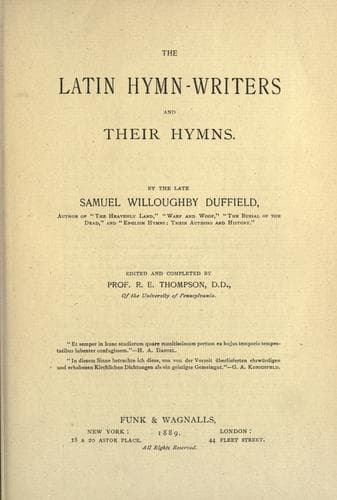
The Latin Hymn-writers and Their HymnsDuffield, Samuel Willoughby
Religion
The Latin Hymn-writers and Their Hymns
Duffield, Samuel Willoughby
Hymns, Latin -- History and criticism
The pope to whom this remarkable document was addressed was a man of
appropriate spirit. He was the third in the series of five able German
popes, who labored so hard in the cause of disciplinary reform. At
Hildebrand’s advice, he had laid aside the papal insignia, which he
donned at his election, and came to Rome as a barefooted pilgrim in
1048. He aimed to put down simony, to stop the barter and sale of
benefices, and to secure the celibacy of the clergy. To this end he used
the synods with vigor, and was ready for almost any proposed reform
which fell in with his line of operations. He was of the German, not the
ultramontane party, and therefore was quite liberal in his construction
of the great text, “Thou art Peter,” and went so far as to say that the
Church should first of all be built upon the true rock, which was
Christ. To him, then, the _Gomorrah Book_ went, and it made a stir.
The next four popes occupied among them no longer period of
ecclesiastical rule than from the year 1054 to the year 1061. Matters
were unsettled. No one continued in office. But the finger of Hildebrand
the cardinal was mightier than the hand of any pope. Nicholas II. was
guided by him, and Alexander II., who came forward in 1061, was
unquestionably under his control. And when Alexander appeared, it seemed
that the _Gomorrah Book_ was still an element of unrest and disturbance,
at a time when the claims of an Antipope (Honorius II.) had been set up
by the Imperialist party, and it was necessary for even Hildebrand’s
friends to give as little offence as possible to the clergy. For the
election of Alexander was clearly irregular, because it was in defiance
of the rules laid down by Nicholas II. at a Lateran Synod in 1059. With
a genial and suave manner the new pontiff now borrowed the work for the
ostensible purpose of having it copied by the help of the Abbot of St.
Saviour. That was the last that Damiani saw of it for some little while.
If Alexander thought that the hermit abbot of Fonte Avellana would
submit to this method of suppression he flattered his soul in vain.
Damiani, after a reasonable delay, appealed to his friend Hildebrand.
The book was like a part of himself, and he had no desire to have it
treated with neglect. One cannot here follow the windings of the story
further than to say that Damiani got his book again, and now we have it
too.
I am surprised at the blindness which prevents some writers from seeing
in this Peter de Honestis a most noble and consistent character. Morheim
only pays him a merited compliment when he says that his “genius,
candor, integrity, and writings of various kinds, entitle him to rank
among the first men of the age, although he was not free from the faults
of the times.” But how could one easily avoid the extreme of severity
who was confronted by the grossest sins that ever carried a hissing
sibilant in front of their names! Flagellation was a natural reaction
from those fleshly lusts that warred against the soul.
Public-domain text, read in full here on John Shaqi.
Reviews
Reviews
No reviews yet
Be the first to share your thoughts on this work.
Elsewhere in the archive
Join the Discussion
Join the discussion
Sign in to leave a comment or review.
Sign InorCreate an account