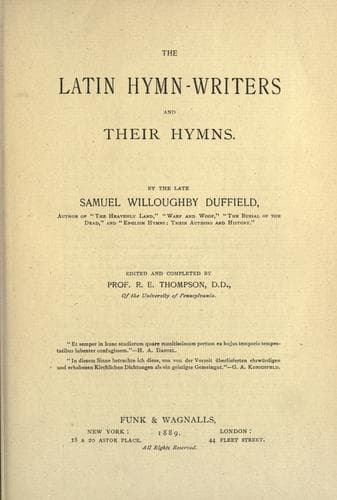
The Latin Hymn-writers and Their HymnsDuffield, Samuel Willoughby
Religion
The Latin Hymn-writers and Their Hymns
Duffield, Samuel Willoughby
Hymns, Latin -- History and criticism
Somehow Hildebrand took a great fancy to this genuine reformer. His own
great schemes were ripening, and Damiani was just the man to be made of
value in the office of cardinal. In 1057, then, the abbot had been
created cardinal-bishop of Ostia by Pope Nicholas II., and in the year
following deacon of the holy college. At first he strenuously resisted
the honor, but was forced to assume it by the Pope’s command. In 1059 he
had acted as papal legate to the semi-independent Ambrosian Church of
Milan. Here he obtained pledges from them that they would conduct their
affairs with purity and agree to receive the authority of the Roman
pontiff.
He did not remain among the cardinals very long. His convent allured
him, and the display requisite to his proper duties was both irksome and
repugnant to him. Therefore he went home again, ardently devoted to
Hildebrand, but devoid of all ambition, and ready to denounce the Pope
or anybody else when it appeared that the rights of the Church were
infringed.
In 1062 Alexander II. found use for him as legate to France, and he
influenced Cluny in favor of Alexander II. In 1068-69 we find him again
a legate in Germany, impressing on young Henry IV. the importance of
submission to Rome. This, too, he effected; and in 1072—the last year of
his life—he appears in the same capacity at the age of sixty six, busy
with the reform of the Church in his native Ravenna.
This is the outline of his story, and it bears no great marks of
difference from others which have been commemorated in ecclesiastical
history. Upon these services, and upon his relations to Hildebrand, a
claim to considerable repute might be established for him. These facts,
however, would not keep him in mind to-day so well as his doctrine of
flagellation and the melody of his two grand hymns.
This matter of flagellation was older than Damiani’s time. It was
permitted in the convents to give five “disciplinary strokes.” Starting
at this point Peter the Honest asks, “Why may we not give the sixth, for
the same reason?” If these five have been inflicted on the unwilling
victim, why should he not secure some credit to himself by taking a
sixth, a seventh, an eighth? The ice once broken, it is easy to see how
the new custom would be seized upon by the ascetic hermits of Fonte
Avellana. The argument is curious, as a specimen of that specious
reasoning to which the ecclesiastic mind was tending, and which, later
on, comes into full bloom among the Jesuit fathers.
Public-domain text, read in full here on John Shaqi.
Reviews
Reviews
No reviews yet
Be the first to share your thoughts on this work.
Elsewhere in the archive
Join the Discussion
Join the discussion
Sign in to leave a comment or review.
Sign InorCreate an account