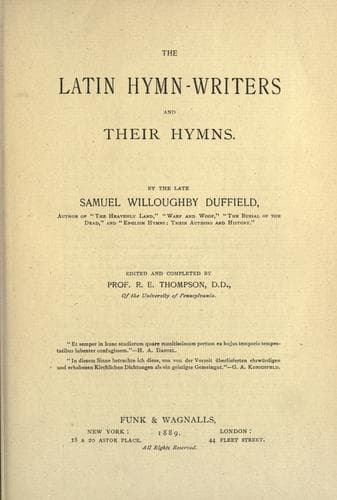
The Latin Hymn-writers and Their HymnsDuffield, Samuel Willoughby
Religion
The Latin Hymn-writers and Their Hymns
Duffield, Samuel Willoughby
Hymns, Latin -- History and criticism
Damiani inquires “if our Saviour was not beaten; if Paul did not
receive, on several occasions, forty stripes save one; if all the
apostles were not scourged; and whether the martyrs had not received the
same punishment. Did not St. Jerome say that these were scourged by
order of God? And who dares deny that they were scourged for others and
not for themselves? Hence, if one undertakes this discipline, willingly,
for himself, he must be doing a good thing.” (See Fleury: _Hist.
Ecclesiastique_, XII., p. 107, _Anno_ 1062.) He then adds the example of
Guy, his predecessor, who died 1046, and of Poppo, a contemporary, who
had died in 1048. The date of his own advocacy of this doctrine is about
1056.
Monte Cassino took up the practice with vigor; but in Peter’s own
convent the most consummate example of flagellation was speedily
developed, and his disciple, Dominic of the Cuirass (_Dominicus
Loricatus_), carries off the palm from all posterity. The method
proposed by Damiani was that the psalter should be recited to the
accompaniment of the blows of the scourge. Every psalm called for one
hundred strokes; the whole psalter for fifteen thousand. By this
spiritual arithmetic three thousand equalled one year of purgatory, and
therefore the complete psalter answered for five years of purgation
removed from either one’s self or one’s neighbor. But Dominic was an
inebriate in his flogging and set himself tasks of stupendous size. He
also improved the art in several respects. He used both hands with
dreadful facility, and frequently lashed his face until it was covered
with blood, singing his psalms the while in a harsh, cracked, and
terrible voice. In the forty days of one Lent he recited the psalter two
hundred times, and inflicted what one reckless calculator calls “sixty
million stripes” upon himself. The true number is three million, which
is clearly sufficient.
At another occasion he literally flogged himself “against time,”
apparently just to see what could be done by a determined man in
twenty-four hours. At the end of that period he had gone through the
psalter twelve times and a fraction over, and had given himself one
hundred and eighty-three thousand stripes, working away with both hands
(as a caustic writer suggests) “in the interest of the great sinking
fund of the Catholic Church.”
Public-domain text, read in full here on John Shaqi.
Reviews
Reviews
No reviews yet
Be the first to share your thoughts on this work.
Elsewhere in the archive
Join the Discussion
Join the discussion
Sign in to leave a comment or review.
Sign InorCreate an account