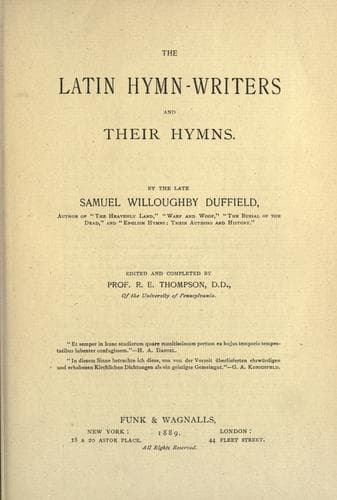
The Latin Hymn-writers and Their HymnsDuffield, Samuel Willoughby
Religion
The Latin Hymn-writers and Their Hymns
Duffield, Samuel Willoughby
Hymns, Latin -- History and criticism
Flagellation, like the dancing mania and the strange parades of the
Turlepins and Anabaptists in the Middle Ages, has its root in nervous
excitement and morbid devotion. Under Anthony of Padua, about 1210, all
Perugia lashed themselves through the streets. Justin of Padua relates
that great disorders and indecency attended the processions. The madness
spread like wildfire through Rome and Italy. In 1260 and in 1261 the
custom was again revived after some decadence, in the same town of
Perugia and under one Rainer. And at this date thousands went out into
Germany led by priests with banners and crosses. Again fading from
public notice, the flagellants reappeared during the progress of the
plague in 1349. Hecker and Cooper supplement the account given by
Boileau. The affair was itself an epidemic. The company marched and sang
hymns—among which was the _Stabat Mater_—and bore tapers and magnificent
banners. They finally became a regular nomadic tribe, separating into
two portions, one of which went to the south and the other to the north.
The Church was powerless, and those _pro_ and _anti_ flagellationists,
who happened to be in ecclesiastical authority, solemnly excommunicated
each other!
The wild license of these scenes was far from aiding either morality or
religion. Clement VI. (1332-52) issued his bull against them. And,
inasmuch as these fanatics had failed to restore a dead child to life in
Strasburg, the malediction of Rome had some effect, and once more the
harsh custom died out.
Then there was another upheaval under Venturinus, a Dominican of
Bergamo, and ten thousand persons joined the order. Like a perennial
plant it again perished and again sprang up in 1414, when these awful
orgies were renewed under the leadership of a person named Conrad. But
now the Inquisition interfered, and among the testimony taken to show
the lengths to which the fanaticism went is the sworn evidence of a
citizen of Nordhausen who, in 1446, asserted that his wife wanted to
have the children scourged just as soon as they had been baptized!
Once more, in the sixteenth century the Black and Gray Penitents
appeared in France. In 1574 the Queen-mother put herself at the head of
the black band in Avignon, and the disorders, indecency, and general
depravity of manners which followed would scarcely be believed even if
it was proper to mention them.
From that date to the present time more or less of this old insanity
occasionally reappears. It affords a singular commentary on our boasted
advance beyond those dark ages, for us to know that the _Penitentes_ of
our own Californian coast do precisely every year what Dominic of the
Cuirass and Anthony of Padua and Conrad and Rainer all did centuries
ago.
And this frightful enginery of fanaticism was set in motion by the man
who wrote one of the loveliest hymns in the Latin language!
Public-domain text, read in full here on John Shaqi.
Reviews
Reviews
No reviews yet
Be the first to share your thoughts on this work.
Elsewhere in the archive
Join the Discussion
Join the discussion
Sign in to leave a comment or review.
Sign InorCreate an account