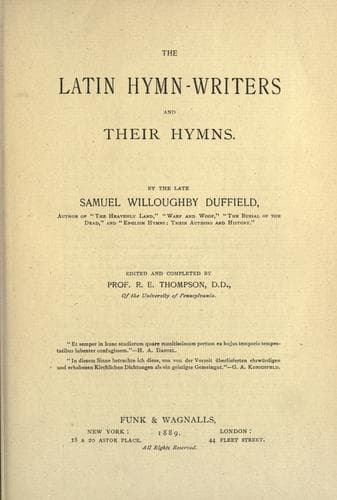
The Latin Hymn-writers and Their HymnsDuffield, Samuel Willoughby
Religion
The Latin Hymn-writers and Their Hymns
Duffield, Samuel Willoughby
Hymns, Latin -- History and criticism
I make no attempt to analyze the feelings that have prompted this
strange austerity. Isaac Taylor has already done this in a most masterly
fashion in his _Fanaticism_. But the essence of it is that wild delusion
which leads men (and even women) to fancy that they can vicariously
atone for others’ sins and “make merit,” as the heathen do, for those
who are less bold than themselves. They have fastened themselves down
like the poor wretched geese doomed to furnish _pattes-de-fois-gras_.
They are before the hot fire of zeal and gorged upon indigestible
dogmas. Hence their charity becomes as abnormal as the livers of the
geese, and the moral epicure, alas, finds in them dainties suitable for
his depraved taste!
It would be a grievous injustice to a good man if Damiani should only
bear with us the character of an ardent zealot and not of a Christian
poet. In this last guise he is at his best. Doubtless he often offends
by his Mariolatry, but he will as often charm by the music of his verse.
He may serve also as a convenient example of this worship of Mary, for
in one of his prayers he has given us the pith and core of that peculiar
devotion. It runs thus:
“O queen of the world, stairs of heaven, throne of God, gate of
paradise, hear the prayers of the poor and despise not the groans of the
wretched. By thee our vows and sighs are borne to the presence of the
Redeemer, that whatsoever things are forbidden to our merits may obtain,
through thee, place in the ears of divine piety. Erase sins, relieve
crimes, raise the fallen, and release the entangled. Through thee the
thorns and shoots of vice are cut down, and the flowers and ornaments of
virtue appear. Appease with prayers the Judge, the Saviour, whom thou
didst produce in unique childbirth, that He who through thee has become
partaker of our humanity, through thee may also make us partakers of His
divinity. Who with God the Father and the Holy Spirit liveth and
reigneth, world without end. Amen.”
I have given this as an example of his prose. Here is a petition
“against a stormy time,” composed in that “leonine and tailed rhyme” in
which Bernard of Cluny, a century later, wrote the _De Contemptu mundi_.
It commences,
“_O miseratrix, O dominatrix, praecipe dictu!_
O thou that pitiest, O thou the mightiest, hark to our crying;
Lest we be beaten down, lest we be smitten down when hail is flying.
Thine is a priestly breast, O thou that succorest, mother eternal
Therefore we pray to thee, lest we be stayed from thee, by storm
infernal.
Quiet the tempest-wrack! Give us the sunshine back for our fair
weather!
Lend us clear light again, make the stars bright again where the
clouds feather!
Virgin, oh cherish thy friends lest we perish by sickness or anger;
Drive all these ills away, thou whose love stills away thunder’s mad
clangor!”
Public-domain text, read in full here on John Shaqi.
Reviews
Reviews
No reviews yet
Be the first to share your thoughts on this work.
Elsewhere in the archive
Join the Discussion
Join the discussion
Sign in to leave a comment or review.
Sign InorCreate an account