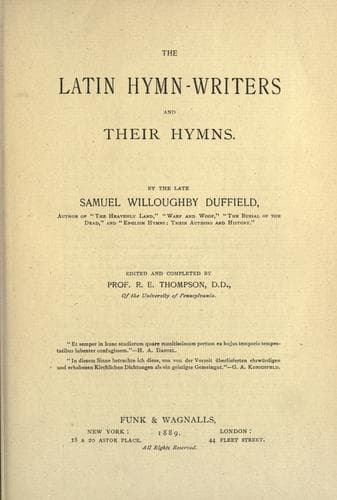
The Latin Hymn-writers and Their HymnsDuffield, Samuel Willoughby
Religion
The Latin Hymn-writers and Their Hymns
Duffield, Samuel Willoughby
Hymns, Latin -- History and criticism
By far the greater part of his hymns are addressed to the Virgin and to
the saints, but there are some others—the _Paule doctor Egregie_, the
_Paschalis festi gaudium_, the _Christe sanctorum gloria_, and the two
powerful judgment hymns, _Gravi me terrore_ and _O Quam dira, quam
horrenda_—which are worthy of note. This _Gravi me terrore_ of the
eleventh century ranks with the _Apparebit repentina_ of the seventh
century. These, together with the _Dies Irae_ of the fourteenth century,
form the great judgment triad of Latin psalmody.
Yet of all the hymns of that or any later time, nothing approaches the
beauty of the _Ad perennis vitae fontem_, of which this Peter Damiani
sings. It is born of Augustine’s thoughts and dreams of the heavenly
land, and some of its phrases are exquisite beyond the possibility of
translation. When Frater Honestus on February 23d, 1072, forever left
that convent of Fonte Avellana, whither Dante went upon his last
recorded journey, then that noble landscape might preserve these
sixty-one lines of Latin verse among the choicest treasures of its dell
and grove. This was no lark that sang against the sun with clarion notes
calling us to such praise as rings through the ancient morning hymn of
Hilary. It was the nightingale of Faenza, sending out those thrilling
tones from the midst of the walls which beheld the eager scholar and to
which the weary cardinal had returned to die. Upon his fame it is set
therefore not like the lark’s song, but the nightingale’s, not as the
flashing diamond, but (in Daniel’s very words) “as a precious pearl for
our treasury.” Mrs. Charles has rendered it into English with grace and
success. Mr. Morgan appends this autograph note to the version in the
copy of his book which is in my possession: “N. B.—This hymn was printed
without revision. If reprinted the metres will be made _equal_.” He has
not attempted to follow the versification of the original. I know of no
other translation except that of R. F. Littledale in _Lyra Mystica_.
Another beautiful hymn which was suggested by the prose of Augustine,
and is ascribed to Peter Damiani by Anselm of Canterbury, who was his
younger contemporary, is the _Quid tyranne, quid minaris_. It is
commonly called
THE ANTIDOTE OF ST. AUGUSTINE AGAINST THE TYRANNY OF SIN.
What are threats of thine, O tyrant,
How can any torture move,
When, for all of thy contriving,
Nothing yet can equal love.
Sweet it is to suffer sorrow,
Futile is the force of pain;
I had sooner die than borrow
Any spot that love to stain.
Heap the fagots as thou pleasest,
Do what evil hearts approve,
Add the sword and cross together,
Nothing yet can equal love.
Pain itself is quite too gentle,
One poor death too brief must be,
I would suffer thousand tortures—
Every woe is light to me!
CHAPTER XVII.
HILDEBERT AND HIS HYMN.
Public-domain text, read in full here on John Shaqi.
Reviews
Reviews
No reviews yet
Be the first to share your thoughts on this work.
Elsewhere in the archive
Join the Discussion
Join the discussion
Sign in to leave a comment or review.
Sign InorCreate an account