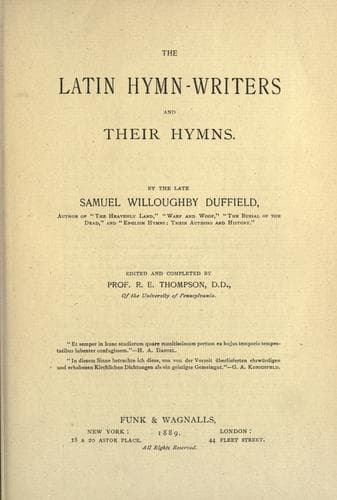
The Latin Hymn-writers and Their HymnsDuffield, Samuel Willoughby
Religion
The Latin Hymn-writers and Their Hymns
Duffield, Samuel Willoughby
Hymns, Latin -- History and criticism
Those who love the “Golden Legend” of Longfellow will remember how
effectively he has there used the Latin songs and hymns. Friar Paul is
so very like the famous Friar John of Rabelais, that he is probably
copied from that worthy. Indeed his _Epistolae Obscurorum Virorum_, with
its dog-Latin and its broad satire on the habits of the monks, was a
most effective weapon in the hands of the reformers. There were a great
many learned men who were by no means equally as pious, and who found
their bodily contentment in the cloister. Against these and all like
them came the constant shafts of ridicule or reproach.
But now, when this same Friar Paul “tunes his mellow pipe” to a
bacchanalian solo in the refectory, we can almost forgive him, forasmuch
as he sings in such capital measure. There is a _Gaudiolum_—a regular
merry-making of monks—down in the cellar; in which, by the way, Lucifer,
disguised in the gray habit, takes his appropriate place. And when Friar
Paul begins on the praise of good liquor, he parodies the metre and
rhyme of the current religious sequences. Listen to him:
“Felix venter quem intrabis,
Felix guttur quod rigabis,
Felix os quod tu lavabis,
Et beata labia!”
Or, as we may express it in our own language:
“Blessed stomach which thou warmest,
Blessed throat which thou reformest,
Blessed mouth whose thirst thou stormest,
Blessed lips to taste of thee!”
Here and there Professor Longfellow introduces also into this “Golden
Legend” his own renderings from the Latin, in little transcriptions
which are exquisitely felicitous. But presently, in sharp contrast to
the ribald Paul and the dissolute Cuthbert and the rest of the noisy
crew in the refectory, he allows us to hear the song of the pilgrims.
They are chanting the Hymn of Hildebert of Lavardin, Archbishop of
Tours:
Me receptet Sion illa,
Sion David, urbs tranquilla,
Cujus faber auctor lucis,
Cujus portae lignum crucis,
Cujus claves lingua Petri,
Cujus cives semper laeti,
Cujus muri lapis vivus,
Cujus custos Rex festivus.”
It is the hope of the Holy City of which they are telling:
“Me, that Sion soon shall pity—
David’s Sion, peaceful city!
Whose designer made the morning;
Whose are gates, the cross adorning;
Whose keys are to Peter given;
Whose glad throng are saints in heaven;
Whose are walls of living splendor;
Whose a royal, true Defender!”
These pilgrims, every now and then, break in with some snatch of melody
from this fine old anthem. And yet there are doubtless those who never
have gone back to see for themselves whence all this beauty has been
taken. But the Hymn of Hildebert would well repay them if they did.
Public-domain text, read in full here on John Shaqi.
Reviews
Reviews
No reviews yet
Be the first to share your thoughts on this work.
Elsewhere in the archive
Join the Discussion
Join the discussion
Sign in to leave a comment or review.
Sign InorCreate an account