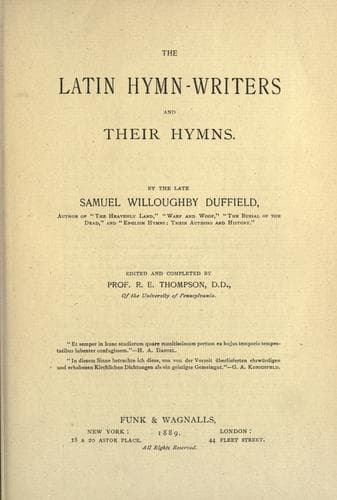
The Latin Hymn-writers and Their HymnsDuffield, Samuel Willoughby
Religion
The Latin Hymn-writers and Their Hymns
Duffield, Samuel Willoughby
Hymns, Latin -- History and criticism
It is the composition of a man who was the Admirable Crichton of his
time—Hildebert of Lavardin, a student under Berenger and Hugo of Cluny.
This is the same poet who, with Wichard of Lyons, is mentioned by
Bernard of Cluny in his preface to the _Hora Novissima_. He says there,
that even these eminent versifiers had never dared to attempt the
measure of his own three thousand lines. And we have abundant other
testimony that Hildebert was an accomplished orator, a successful
controversialist, a brilliant rhetorician, a poet of ten thousand lines,
and the author of this majestic and beautiful composition. He was born
in the year 1057 (or 1055) at Lavardin, near Vendôme, in France, was
first head-master of a school, then an archdeacon, then instructor in
theology and Bishop of Le Mans (1097), and finally (1125), Archbishop of
Tours, from which he derives his name of “Turonensis.” He was of humble
origin and not connected with the celebrated family of Lavardia, except
through the accident of his birthplace being in their vicinity.
Perhaps—if we follow one scurrilous old biographer—we may fancy the holy
Hildebert to have been very little of a saint in his early days.
Baronius indeed lends color to the assertion (made originally by
Godfrey, the Dean of Le Mans) that the vices which Hildebert afterward
attacked were matters of personal experience with himself. A certain
coarse assault was undoubtedly made upon him; but envy and malignity
went even to greater lengths then than now—and they are not noticeably
moderate or truthful at present. He was a “wise and gentle prelate,”
says Trench, “although not wanting in courage to dare, and fortitude to
endure, when the cause of truth required it.” Neander’s estimate of his
character (_The Life of St. Bernard_) is also kind. I doubt, therefore,
whether any such statements can be maintained. But we all know too well
what that age was, for us to be over-enthusiastic in the defence of our
favorites. And still it can truly be said that Hildebert established his
innocence there and then. He finally died in 1134, and his works, with
those of Marbod, were collected and published in Paris by the
Benedictines, at the comparatively recent date of 1708. His hymn,
_Oratio devotissima ad tres Personas Sanctissimae Trinitatis_, first
appeared in the Appendix to Archbishop Ussher’s _De Symbolis_ (1660),
and again was published by the Norman Jacques Hommey in 1684.
Public-domain text, read in full here on John Shaqi.
Reviews
Reviews
No reviews yet
Be the first to share your thoughts on this work.
Elsewhere in the archive
Join the Discussion
Join the discussion
Sign in to leave a comment or review.
Sign InorCreate an account