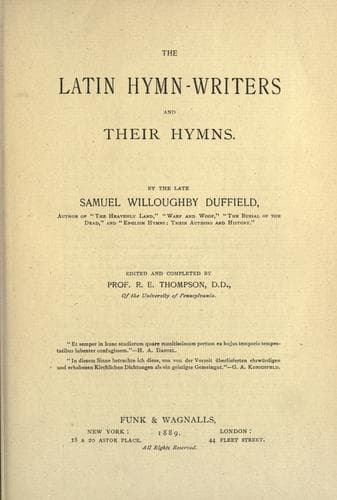
The Latin Hymn-writers and Their HymnsDuffield, Samuel Willoughby
Religion
The Latin Hymn-writers and Their Hymns
Duffield, Samuel Willoughby
Hymns, Latin -- History and criticism
I wish that I could quote the beautiful picture that Vaughan (_Hours
with the Mystics_, Book V., chap. 1) has given of this fine enterprise.
We should see Bernard and his monks chopping and binding fagots;
planting vines and trees of goodly fruit; rearing their cloistral
buildings, when the time arrived, out of the very materials about them,
and so steadily transforming purgatory into paradise. There should we
see the river bending its great shoulders to the wheels that drive
fulling-mill and grist-mill; or toiling for them in their tannery, or
filling their _caldarium_. We should see the monks at vintage or at
harvest; pressing the clusters from yonder hill, or gathering the hay
from yonder meadow. And everywhere throughout this busy, energetic life,
we should behold the wasted figure of their chief—austere, sincere,
severe. And we should feel that unaccountable personality—that
intrinsic, magnetic, controlling quality which made this the man above
all others to be the opposer of schismatics, the counsellor of kings,
the establisher of popes, and the preacher of the Second Crusade.
Clairvaux was his kingdom, and from Clairvaux he ruled the mediaeval
world.
His personal appearance was in keeping with this idea—it was the evident
cause of an evident effect. He was taller than the middle height and
exceedingly thin. His complexion was “clear, transparent,
red-and-white;” and always he had some color in his wasted face. His
beard was reddish, and—according to his ancestral derivation, called
_Sorus_ or “yellow-haired”—his own hair was light and perhaps tawny.
This beard grows whiter in the course of years, and these hollow cheeks
glow with the enthusiasm of the orator as he speaks. Then he is at his
best! He flings aside all feebleness; he disregards every consideration
except the truth; he flashes and glitters as the tremendous squadrons of
his brilliant logic, or still more brilliant exhortation, press down
upon the listening soul. He had indeed a perfect confidence in himself,
in his methods, and in his ultimate success. He was like a modern ocean
steamer, iron-hulled, steam-driven, sharp-prowed, cutting through all
storms without detention, and riding the wildest waves in his triumphant
course to victory.
There is in Bernard of Clairvaux a most singular combination of the
dreamer and the man of affairs. Vaughan has too admirably condensed the
story of these interruptions and occupations, for me to avoid quoting,
at least this much, from his capital monograph:
Public-domain text, read in full here on John Shaqi.
Reviews
Reviews
No reviews yet
Be the first to share your thoughts on this work.
Elsewhere in the archive
Join the Discussion
Join the discussion
Sign in to leave a comment or review.
Sign InorCreate an account