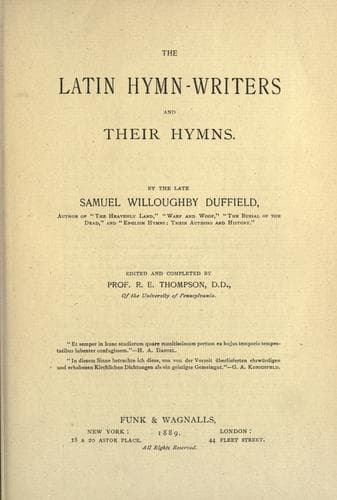
The Latin Hymn-writers and Their HymnsDuffield, Samuel Willoughby
Religion
The Latin Hymn-writers and Their Hymns
Duffield, Samuel Willoughby
Hymns, Latin -- History and criticism
“Struggling Christendom,” he says, “sent incessant monks and priests,
couriers and men-at-arms to knock and blow horns at the gate of
Clairvaux Abbey; for Bernard, and none but he, must come out and fight
that audacious Abelard; Bernard must decide between rival popes, and
cross the Alps, time after time, to quiet tossing Italy; Bernard alone
is the hope of fugitive Pope and trembling Church; he only can win back
turbulent nobles, alienated people, recreant priests, when Arnold of
Brescia is in arms at Rome, and when Catharists, Petrobrusians,
Waldenses and heretics of every shade, threaten the hierarchy on either
side the Alps; and at the preaching of Bernard the Christian world pours
out to meet the disaster of a new crusade.”
Yet with all this he is a profound scholar, and his comments on
Scripture are of a mystical, and often of a serenely spiritual and
thoughtful kind, as though no intrusion could jar the harmony and poise
of his soul. His was that strange contradiction of nature which found
its calm in tumult and its ecstasy in conflict. Obstructions pass away.
Like that later mystic, Novalis (Friedrich von Hardenberg), there are no
hindrances in his communion with the unseen world; he could, perhaps, do
as Novalis did when Sophie Kühn died. For the poor fellow records in his
diary: “Much noise in the house. I went to her grave and had a few wild
moments of joy.” And of him also Just declares: “No spirit-dream was too
high, no business detail too low;” for Novalis in 1799 was “Assessor and
Law-adviser to the Salt Mines of Thuringia.” Pegasus in harness appears
no worse a contradiction than a mystic in a salt-pan, or a Bernard
epistolizing the Count of Champagne about a drove of stolen pigs.
Prose and poetry, poetry and prose! And yet the brain and soul that can
do good work in the one are by no means disqualified for the other; and
your truest mystics are not likely to wear long hair and talk raving
nonsense among impractical neologists. For Bernard, even though he made
converts wherever he went, and drew increasing numbers into cloister
walls, exerted a potent and prevalent influence upon his time. He is one
of the lighthouses, as we sail down the coast of the Middle Ages; and
not until we pass him and his compeers, do the real darkness and the
dull ignorance, the shoals and the unmarked rocks appear, ready to wreck
the ventures of the mind. How gladly one would linger over these
fascinating incidents in this remarkable career! The man’s life was
expressed in some of his own aphorisms. They are such as these:
“There is no truer wretchedness than a false joy.” “He does not please
who pleases not himself.” “You will give to your voice the voice of
virtue if you have first persuaded yourself of what you would persuade
others.” “Hold the middle line unless you wish to miss the true method.”
Public-domain text, read in full here on John Shaqi.
Reviews
Reviews
No reviews yet
Be the first to share your thoughts on this work.
Elsewhere in the archive
Join the Discussion
Join the discussion
Sign in to leave a comment or review.
Sign InorCreate an account