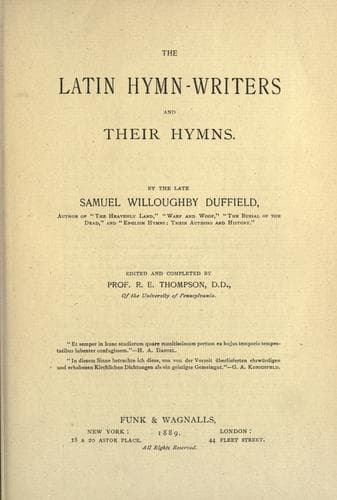
The Latin Hymn-writers and Their HymnsDuffield, Samuel Willoughby
Religion
The Latin Hymn-writers and Their Hymns
Duffield, Samuel Willoughby
Hymns, Latin -- History and criticism
These are the maxims of an orator as well as of a statesman. And the
junction of imagination, analysis, logic, fervor, and faith, made this
man what he was. Already he had tried his wings in preaching to his own
monks at morning and evening; and they had listened to him as though he
had come from another world. He dealt with the great and vital questions
of the moral nature. Like the best of our modern preachers, he aimed to
sustain the soul, to arouse and to cheer it, and to bid it press forward
to a victory which he himself foresaw. He might have said of such
aspiring saints as surrounded him what Roscoe says:
“I see, or the glory blinds me
Of a soul divinely fair,
Peace after great tribulation
And victory hung in the air.”
He felt, with Lacordaire, that the Gospel had a new meaning, when he
discovered that it was intended for the comfort of the human heart. He
was at one with his monks; and as he reached out toward the social life
about him, and toward the turbid torrents of politics and
ecclesiasticism over which he must throw the bridge of charity or of
faith, he simply transferred the Clairvaux method into the affairs of
men.
It was an age of destruction, and into it he was casting the salt of the
Gospel, hoping at least to make it salvable. Around his life needless
legends and superstitious traditions have combined to cluster, but the
real Bernard is distinct from both. He never relaxed his grip upon
himself or upon others. And while this is not yet the place to speak of
the famous controversy with Abelard, it may be properly said that
Bernard saw tendencies in that philosophy which were genuinely
dangerous; and that he defeated them because truth (however narrow and
selfishly employed) is always stronger than error. Such was also his
power in preaching the crusade in 1145, when he was about fifty-five
years of age. It sprang from the quenchless fire of his zeal, as when at
Vezelai, standing by the side of Louis VII., he caused such enthusiasm
in the crowd beneath, that he did nothing so long as he remained in the
town but make crosses for them to wear in sign of their holy purpose.
Public-domain text, read in full here on John Shaqi.
Reviews
Reviews
No reviews yet
Be the first to share your thoughts on this work.
Elsewhere in the archive
Join the Discussion
Join the discussion
Sign in to leave a comment or review.
Sign InorCreate an account