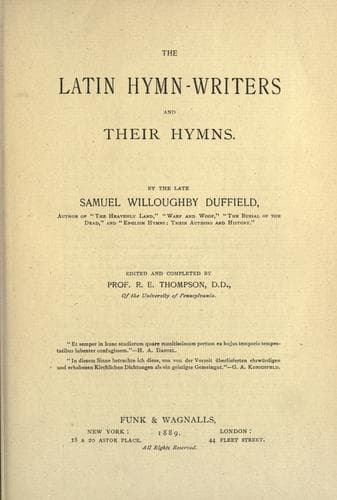
The Latin Hymn-writers and Their HymnsDuffield, Samuel Willoughby
Religion
The Latin Hymn-writers and Their Hymns
Duffield, Samuel Willoughby
Hymns, Latin -- History and criticism
Meanwhile, though the lectures suffered, and the students saw, and all
Paris smiled, Fulbert was totally in the dark. This condition of affairs
was predestined to come to an end, and it came in storm and anger.
Abelard saw himself forced, against his will, to marry secretly. It was
a sting to his egotism that ever rankled. It served, though, to pacify
Fulbert and the rest of the relations; and being too glad and too
loose-tongued to keep this handsome alliance from the public they
presently told everybody. Heloise, thereupon, fearing for Abelard’s
ambitious schemes, did not shrink from a point-blank falsehood. She
denied the marriage. She had been in Brittany and was now at Argenteuil,
of which she was by and by to become the abbess. And she added to her
denial the self-abnegating sentiment that Abelard, who was created for
all mankind, ought not to be sacrificed by “bondage to a woman.” It was
worthy of her who so admired the “philosophic Aspasia,” and whose tutor
and lover had done what he could to make her as “free from superstition”
as himself. Her moral ideas were what he taught her, and he could not
unteach them.
Among the complaisant and agreeable nuns of Argenteuil she now resided.
It was but a few miles from Paris. Her husband frequently went thither,
and in a short time thereafter she was enrolled as a novice. The fact
aroused her relatives, and their mutterings became ominous; Fulbert,
especially, taking this act in high dudgeon, as though it meant the
premeditated repudiation of his niece. Their anger did not stop at
words, but, knowing Abelard’s popularity, and fearing to attack him
during the day, they bribed his valet and assaulted him by night in his
own apartment.
It was this blow which flung Abelard from heaven to hell. His hitherto
impregnable attitude; his fierce zeal for his opinions; his hopes of a
new philosophy which should make his name immortal, all vanished before
it as spider-webs break before a sword. And when, conscious that he was
no more a god and a hero, but an insulted and defeated man, he rose from
his bed of pain, the prospect was not improved. The outpoured
indignation of bishops and canons and clergy—the lamentations of the
women and the students—did not appease him. A whisper was in his soul
like that of Haman’s wife. Mordecai, the despised, was coming to the
kingdom and the Agagite was doomed.
There were reasons which led him to think of seeking aid from the Pope
against his enemies. But Fulk of Deuil, his good friend, advised him not
to try it. “You have no money,” said honest, plain spoken Fulk, “and
what can you do at Rome without money?” It was bitter truth. Yet the
Abbé Migne, forgetting the much worse things Bernard had said of the
Roman Curia in the treatise _De Consideratione_, exscinds the passage
from Fulk’s letter on the ground that it would cause “scandal to
Catholic ears.” Edification first, truth afterward, if at all!
Public-domain text, read in full here on John Shaqi.
Reviews
Reviews
No reviews yet
Be the first to share your thoughts on this work.
Elsewhere in the archive
Join the Discussion
Join the discussion
Sign in to leave a comment or review.
Sign InorCreate an account