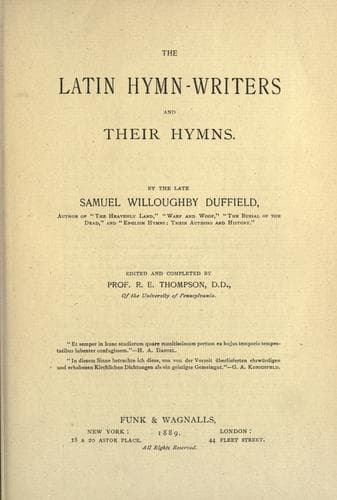
The Latin Hymn-writers and Their HymnsDuffield, Samuel Willoughby
Religion
The Latin Hymn-writers and Their Hymns
Duffield, Samuel Willoughby
Hymns, Latin -- History and criticism
Therefore, with a poisoned soul, he sought the Abbey of St. Denis to
hide himself from the gaze of the world. To a man so proud a life
without imperial power was a living death. Yet from those walls he
issues his edict that Heloise shall take the veil. His vanity led him to
carry out the original cause of hostility even to its unalterable
result. But Heloise, whatever she might have thought or felt, marched
with lofty resignation to her fate. Quoting aloud—as his confession
pitifully recalls—the words of Cornelia to Pompey from the “Pharsalia”
of Lucan, she takes the vows. Never was there less of religion in such a
ceremony! Henceforth she walks like the moon in distant brightness,
coming to meet us down the ages as comes the Queen Louise of Gustav
Richter’s superb picture. She is transfigured by her self-forgetting
love, and “all that is left of her,” in the best and truest sense, is
now “pure womanly.”
For Abelard at St. Denis the case was different. He found the monks
worldly and dissolute and he reproved them. The effect was similar to
the case of Lot—the reformer departed with all his belongings. He then
renewed his old lectures. His scholars followed him to Maisoncelle,
where, in their avidity of knowledge, they overcrowded every resource of
shelter and food. He offered them that fascinating combination,
dialectics and divinity. Like the saltpetre and the charcoal these were
harmless when apart and explosive when together, particularly if you add
the sulphurous heart which now smoked in his bosom. A harsh and
vindictive tone was given to his disposition, and it was natural that he
should be, at least tentatively, a heretic. These moral bruises are
worse than any or all physical injuries; the man who has felt them can
never be again what he was before. And now Anselm and William and
Fulbert and everybody that he had bullied or taunted or threatened
turned upon him. The gates to the black cavern of the winds were open
and the blasts of fate were icy cold.
The papal legate Conan held a council at Soissons in 1121. The opinions
of Abelard were received with disfavor. They humiliated the poor wretch
among them and made him burn his own book, and then mumble through a
_credo_ amid his “sobs and sighs and tears.” These words are his own,
and his is also the statement that he was put into the custody of the
Abbot of St. Medard and there he was lectured, and even lashed by the
convent whip, until he exhibited proper submission. Poetical justice had
befallen him. For he confesses, to his shame, that he had coerced and
even struck Heloise. Now he, too, was coerced, and he, too, was struck.
Public-domain text, read in full here on John Shaqi.
Reviews
Reviews
No reviews yet
Be the first to share your thoughts on this work.
Elsewhere in the archive
Join the Discussion
Join the discussion
Sign in to leave a comment or review.
Sign InorCreate an account