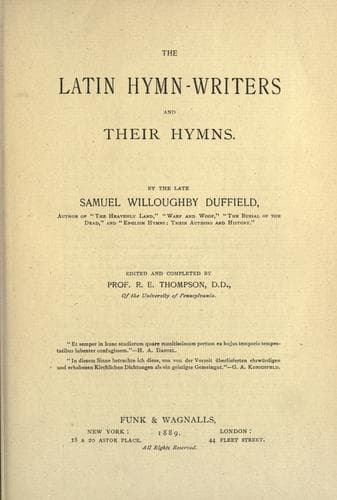
The Latin Hymn-writers and Their HymnsDuffield, Samuel Willoughby
Religion
The Latin Hymn-writers and Their Hymns
Duffield, Samuel Willoughby
Hymns, Latin -- History and criticism
Then back again to St. Denis, with more hatred and hard speeches than
ever. But Suger, the new abbot, an easy-going lover of bric-à-brac and
good living, set him free, a “masterless man” past forty years of age,
with Heloise out of reach and the spears of exultant enemies bristling
in every hedge. Is it a wonder that he took to the banks of the Ardusson
near Troyes, wattled himself a rude hut and resolved to be a hermit? But
even there in the desert the people thronged him and built a village of
huts about his own. His misfortunes became a portion of his strength.
And there they erected for him a church and a cloister which he
dedicated to the Paraclete, a daring innovation, since it was then
considered highly heterodox thus to distinguish one person of the
Trinity from the other two.
Under such storms and heat the nature of the man had been seriously
warped. He became suspicious, gloomy, and weakly unstable. His
correspondence with Heloise had been completely broken off. He went into
the monotonous Champagne, then out into the bleak Brittany, and finally
(1125) he received the abbacy of St. Gildas. His friends, perhaps,
desired to save him from homelessness and so from the dangers which the
relentless malice of his old enemies was constantly piling up. But their
choice of a refuge reveals how little their ecclesiastical influence was
worth. The monks of St. Gildas lived in open sin, and the people around
the cloister were semi-barbarians. It may be that they were ready to
welcome Abelard because they supposed he would be charitable to their
peccadilloes, but if they fancied this, their mistake was great. He
really measured himself against their vices and suffered a predestined
defeat. At St. Gildas he touched the nadir of his fate as at Paris he
had reached its zenith. The monks conspired against him. They sought to
poison him, contaminating with their drugs even the cup of the
Eucharist. When his life was not fear it was horror, and when it was not
horror it was despair.
At this time, too, for calamity never comes singly, Suger had succeeded
in routing from Argenteuil the Abbess Heloise with all her nuns. He had
complained to Rome that the lands of Argenteuil were the chartered right
of St. Denis and that the nuns were very scandalous. So Abelard roused
himself sufficiently to hand the deserted abbey of the Paraclete over to
his wife; to confirm it by every possible act and deed against invasion;
and to secure, in the despite of Bernard of Clairvaux, who was his
presumptive enemy, a special bull of Innocent II. to make all this
permanent. To these walls Heloise therefore removed. They were doubly
dear to her for Abelard’s sake. She had no true “vocation” for her
office, but the Pope called her and her sisterhood his “dear daughters,”
and it was the best that they could do. Abelard prepared their forms of
service for them, and thus again, after all these years, communication
existed and letters passed between them.
Public-domain text, read in full here on John Shaqi.
Reviews
Reviews
No reviews yet
Be the first to share your thoughts on this work.
Elsewhere in the archive
Join the Discussion
Join the discussion
Sign in to leave a comment or review.
Sign InorCreate an account