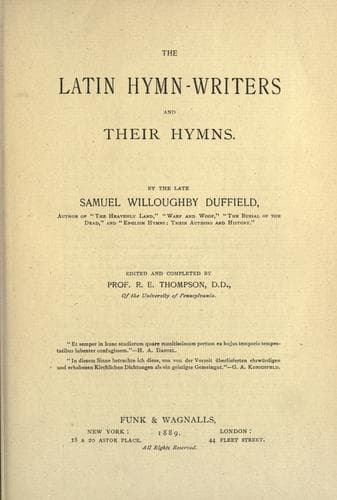
The Latin Hymn-writers and Their HymnsDuffield, Samuel Willoughby
Religion
The Latin Hymn-writers and Their Hymns
Duffield, Samuel Willoughby
Hymns, Latin -- History and criticism
There had already been a controversy with St. Bernard about Robert,
Bernard’s cousin, who liked the cordiality of Cluny a good deal better
than the thin-visaged and almost fierce zeal of Clairvaux. For this
reason he changed his allegiance. Consequently Bernard wanted him sent
home. And by this time he was, according to strict rule, actually
restored. However, Clairvaux chuckled very much at the confusion in
Cluny; and Bernard was ungenerous enough to take this time, of all
others, to publish quite an elaborate and even brilliant disparagement
of the Cluniac rule. I shall let this also pass for the present, for it
will meet us again, only saying that Peter seems to have gone on wisely
about his own business and avoided any reply—a quite unusual proceeding
in a controversial age. In 1126 he had taken up again his previous line
of administration; and when this “apology” came out in 1127 he was
practically meeting its objections in the best manner. As Frederick
Maurice says of him, “The Abbot of Cluny would have wished the monk to
be rather an example to men of the world of what they might become, than
the type of a kind of life which was in opposition to theirs. He feared
that a grievously stringent rule would lead ultimately to a terrible
laxity.”
In 1130 Pope Honorius died. Pierre de Leon (Peter Leonis), calling
himself Anacletus, got himself illegally elected, and seized the control
at Rome. Cardinal Gregory of San Angelo, who was the rightful but weaker
claimant, assumed the title of Innocent II., and forthwith set out to
secure the help of the great abbeys of France. Now Anacletus had been a
Cluniac; and Bernard, Peter’s and Cluny’s opponent, favored Innocent.
But when Innocent, in 1132, appeared at Cluny, he was hailed as the true
and genuine Pope—a piece of magnanimity which he had no right to expect.
And from this time Peter’s allegiance was undoubted; although, like a
great many persons in the world, Innocent II. conceded more to the stern
will of Bernard than to the generous conduct of the Abbot of Cluny.
Indeed, he did but very little in the way of privilege for Peter’s
abbey; and he turned nearly all his gifts and favors toward Bernard.
This so exalted the Cistercians that Peter protested. It is a blot upon
Innocent that such a protest was needed. For Peter had been the first to
welcome him, sending him “sixty horses and mules, with everything which
could be wanted by a pope in distress.”
Public-domain text, read in full here on John Shaqi.
Reviews
Reviews
No reviews yet
Be the first to share your thoughts on this work.
Elsewhere in the archive
Join the Discussion
Join the discussion
Sign in to leave a comment or review.
Sign InorCreate an account