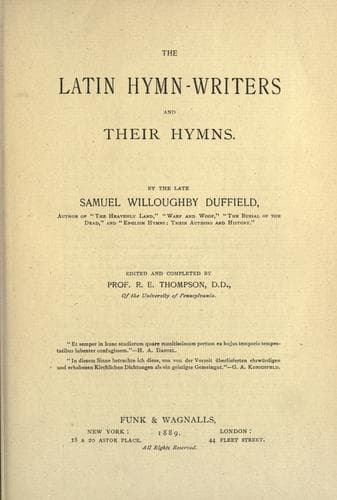
The Latin Hymn-writers and Their HymnsDuffield, Samuel Willoughby
Religion
The Latin Hymn-writers and Their Hymns
Duffield, Samuel Willoughby
Hymns, Latin -- History and criticism
Many a man would have wheeled around and left the ingrate. But Peter’s
revenge was handsome and characteristic. He summoned a general chapter
of his order; and it was held at the time that Innocent, recognized at
length, was going away to Rome. There were “two hundred priors and a
thousand ecclesiasts,” delegates from France, England, Spain, Germany,
and Italy. These cheerfully and promptly agreed to accept a more
stringent rule in all their religious houses. And thus Innocent, and his
Warwick of a Bernard, could see for themselves the strength and the
charity, and the sincere purpose of the man whom they were setting
aside. I feel that I must here add the exact words in which Morison, St.
Bernard’s best biographer, justifies this estimate of the character of
Peter the Venerable. “The relations between Peter and Bernard throughout
their lives,” he says (p. 222, _note_), “give rise to contrasts little
favorable to the latter. Peter nearly always is gentle, conciliating,
and careful not to give offence, even when as here (in the case of the
Bishop of Langres) sorely provoked. Bernard too often made return by
hard and even violent language and conduct.”
With such a stately and well-balanced person in our mind’s eye, we
cannot be surprised to find that he had plenty of solid pluck, that he
was “mild as he was game, and game as he was mild.” In 1134, returning
from the Council of Pisa against Anacletus, he and his followers were
attacked by robbers. The abbot tucked up his sleeves, and took the sword
of the Church militant on the spot. Perhaps he was glad to let his big
thews and sinews have full play. At all events he so dashed and smote
these ungodly men, that he beat them actually back, and had therefrom
considerable glory. I never read that he or his abbey was much meddled
with afterward.
About this date his visits to Spain drew his attention to the Koran. He
was struck by the religious efficiency of it, and in order to meet it
better he prepared for a full translation of it. Peter of Toledo,
Hermann of Dalmatia, and an Englishman named Robert Kennet, or perhaps
(says the _Histoire Litteraire_) de Retines, were selected for this
duty. To them were added an Arab scholar and Peter of Poitiers, the
abbot’s favorite private secretary. They were to render the Koran into
Latin directly; and at it they went, accomplishing their task between
1141 and 1144, at the time of an epidemic in the monastery. Then Peter
himself joined with them in a refutation of its errors—albeit his
Latinity was not first-rate, being rather that of a man of affairs than
of a student. There was another Latin refutation of the Koran by Brother
Richard, a Dominican who lived in the thirteenth and into the fourteenth
century. Luther translated that into German in 1542.
Public-domain text, read in full here on John Shaqi.
Reviews
Reviews
No reviews yet
Be the first to share your thoughts on this work.
Elsewhere in the archive
Join the Discussion
Join the discussion
Sign in to leave a comment or review.
Sign InorCreate an account