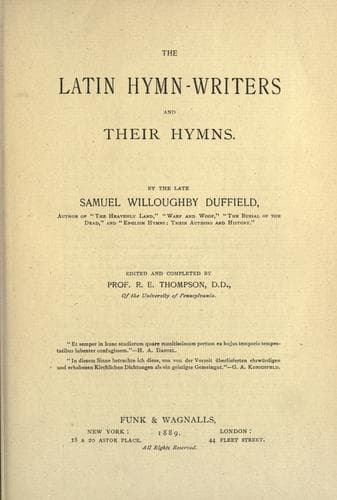
The Latin Hymn-writers and Their HymnsDuffield, Samuel Willoughby
Religion
The Latin Hymn-writers and Their Hymns
Duffield, Samuel Willoughby
Hymns, Latin -- History and criticism
What a warm-blooded, good, hearty fellow Peter must have been! He had
only found three hundred monks at Cluny in 1122; but Hugo of Cluny, his
successor, was entitled to take rule, there and elsewhere, over ten
thousand. Mount Tabor, the Valley of Jehoshaphat, and Constantinople
were among the places where the “black” monks were well established. And
a large share of this was due to the sagacity and statesmanship of
Peter. In proof of this fine humanity, take his behavior to Abelard. The
full story comes properly in another place; for Abelard himself was a
writer of hymns, and worthy of more than transient reference. But when
poor Abelard was repudiated, disgraced, shamefully mutilated, and nearly
at despair’s edge, wearied out with St. Gildas and his refractory monks,
and finally defeated by the purer and higher logic of Bernard, then,
indeed, do we see Peter of Cluny at his best. He received the
disappointed and broken man with “the welcome of an unutterably
guileless and sympathetic heart.” Cluny’s gates opened wide to take him
in. Cluny’s genial, restful spirit closed in about his own like the
feathers of the mother bird around her callow, shivering brood.
And when he dies, it is Cluny’s abbot who details with the loving
particularity, which would most help the sore heart of Heloise, all his
last doings. He speaks even to the kinship of every age when, after this
long and tender letter, whose Latin glows with a deep fervency, he
closes in this wise: “May God, in your stead, comfort him in his bosom;
comfort him as another you; and guard him till through grace he is
restored to you at the coming of the Lord, with the shout of the
archangel and the trump of God descending from the heavens.”
It is time that we speak of his writings, of which a full edition was
published at Paris in 1522, one of the Cluniac monks being its compiler.
Frequently, during the next two hundred years, they are republished in
whole or in part. They are thus by no means inaccessible, though their
merit is not so great. One of the important works is directed against
the Jews, for whom he had a most pious dislike. Others are in the nature
of epistles or of controversial replies, valuable only for their time
and their spirit.
Of his verse, however, we have left us but about fourteen specimens. One
of these is against the detractors of the poetry of Peter of Poitiers,
who were nearer right than he supposed them to be. Another is a rhymed
epistle to a certain Raimond, of some sixty-four lines. Then we have a
“prose,” the word being cognate to _prosody_, in honor of Jesus Christ.
Its structure, except for the additional short syllable, is identical
with the “leonine and tailed rhyme” of Bernard of Morlaix, his prior:
“A patre mittitur, in terris nascitur, Deus de virgine
Humana patitur, docet et moritur, libens pro homine.”
Public-domain text, read in full here on John Shaqi.
Reviews
Reviews
No reviews yet
Be the first to share your thoughts on this work.
Elsewhere in the archive
Join the Discussion
Join the discussion
Sign in to leave a comment or review.
Sign InorCreate an account