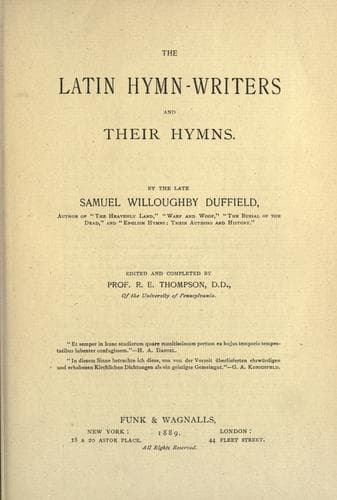
The Latin Hymn-writers and Their HymnsDuffield, Samuel Willoughby
Religion
The Latin Hymn-writers and Their Hymns
Duffield, Samuel Willoughby
Hymns, Latin -- History and criticism
It celebrates Him, sent from the Father, born on the earth, God from a
virgin, wearing our mortal shape, teaching and tarrying with us, and
atoning for our sins. The best, perhaps, of all his poems is what Trench
and March quote:
“Mortis portis fractis, fortis
Fortior vim sustulit,”—
the real original of those splendid lines:
“Now broken are the bars of Death,
And crushed thy sting, Despair!”—
which we find in Bishop Heber’s resurrection hymn, commencing, “God is
gone up with a merry noise.” There is a life to these verses which one
must understand their author in order to appreciate. They follow, in the
best attire that I can give them. They are exultant rather than
illustrious. It is the man and not his measures whom we celebrate!
Daniel does not think it worth his while to include him at all.
Archbishop Trench takes his own text from the _Bibliotheca Cluniacense_,
Paris, 1614:
ON THE RESURRECTION OF OUR LORD.
The gates of death are broken through,
The strength of hell is tamed,
And by the holy cross anew
Its cruel king is shamed.
A clearer light has spread its ray
Across the land of gloom
When he who made the primal day
Restores it from the tomb.
For so the true Creator died
That sinners might not die,
And so he has been crucified
That we might rise on high.
For Satan then was beaten back
Where he, our Victor stood;
And that to him was deathly black
Which was our vital good.
For Satan, capturing, is caught,
And as he strikes he dies.
Thus calmly and with mighty thought
The King defeats his lies,
Arising whence he had been brought,
At once, to seek the skies.
Thus God ascended, and returned
Again to visit man;
For having made him first, he yearned
To carry out his plan.
To that lost realm our Saviour flew,
The earliest pioneer,
To people Paradise anew
And give our souls good cheer.
Peter the Venerable died on December 25th, 1156; but how or with what
surroundings we are not told. He was buried beside his old comrade,
Henry of Blois, Bishop of Winchester, within the walls of the church
which Innocent II. consecrated upon his memorable visit to Cluny. And
the _Histoire Litteraire_ breaks out into an unusual eulogy; and
declares that in his case the title of “Venerable” was no less honorable
than that of “Saint.” They did not make “saints” out of such men as
Peter—and I don’t quite see why they should. There was too much
flesh-and-blood reality about him, too little of musty theology and
altogether too little bigotry. But somehow the broad-faced happy sun
proves himself to be the “greater light;” while the moon goes palely on,
a ghost in an unaccustomed sky.
CHAPTER XXI.
BERNARD OF CLUNY.
Public-domain text, read in full here on John Shaqi.
Reviews
Reviews
No reviews yet
Be the first to share your thoughts on this work.
Elsewhere in the archive
Join the Discussion
Join the discussion
Sign in to leave a comment or review.
Sign InorCreate an account