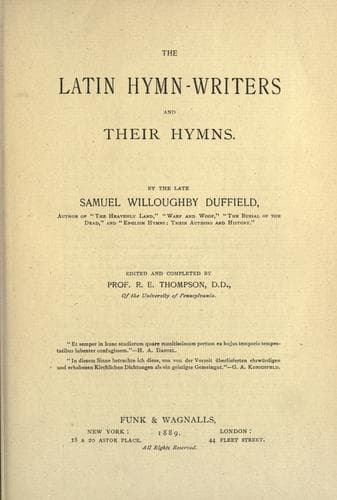
The Latin Hymn-writers and Their HymnsDuffield, Samuel Willoughby
Religion
The Latin Hymn-writers and Their Hymns
Duffield, Samuel Willoughby
Hymns, Latin -- History and criticism
In the twelfth century—the time of the great Crusades—we find the
noblest and purest of Latin hymns. It is the age of Hildebert, Abelard,
Bernard of Clairvaux, Peter of Cluny, and Adam of St. Victor. But among
them all I find no one who has inspired a deeper and more lovely desire
for the heavenly land than Bernard of Cluny.
The information about him is very meagre. He was born at Morlaix in
Brittany, of English parents. He seems to have attained to no
ecclesiastical dignity—such men seldom care for baubles and trinkets.
But his is as true a soul as ever burned like a star on a summer night,
against the warm, obscure, palpitating heaven of eternal hope. The date
of his prominence is fixed by the fact that Peter the Venerable was his
abbot, and it is therefore included between 1122 and 1156. I have (in
_The Heavenly Land_) myself assigned the _Laus Patriae Coelestis_—his
famous and only poem, which is addressed to Abbot Peter, to 1145 or
thereabouts.
His single up-gush of melody is a lamentation over the evil condition of
the times in which he lives. They were indeed days to sadden the soul of
the saint; and he called his poem _De Contemptu Mundi_; for he despised
the _immundus mundus_—the foul world in which he was forced to remain.
It consists of some three thousand lines of dactylic hexameter, and was
first published (so says Trench, who is its step-parent) by Matthias
Flacius Illyricus in his scarce and little known supplement to the
_Catalogus Testium Veritatis_. In this “Catalogue of Witnesses to the
Truth” he gathers all those who have testified against the papacy, and
the supplement, _Varia doctorum piorumque Virorum de Corrupto Ecclesiae
Statu Poemata_ (1556), is made up of hymns and poems in which the pious
_within_ the Church, as well as without her walls, sorrowed over her
corruption.
Bernard’s poem is sometimes known, therefore, by his own title, _De
Contemptu Mundi_, and sometimes by that given by Trench to his cento of
about one hundred lines, _Laus Patriae Coelestis_, the “Praise of the
Heavenly Land.” From this cento one would derive altogether an erroneous
idea of the whole; but Dr. Neale, who wrote with the full text before
him, although he paraphrased but part of it, tells us that the poem, in
great part, is a bitter satire on the fearful wickedness of the times.
It was the part Trench passed by for which Matthias Flacius Illyricus,
its first editor, cared the most. The sins and greediness of the Court
of Rome are the theme of the eighty-five lines he has embodied in the
text of the _Catalogus_ itself. By both that and the poems of his
supplement, he sought to justify the Protestant Reformation on the side
of Christian discipline and morals.[10]
Public-domain text, read in full here on John Shaqi.
Reviews
Reviews
No reviews yet
Be the first to share your thoughts on this work.
Elsewhere in the archive
Join the Discussion
Join the discussion
Sign in to leave a comment or review.
Sign InorCreate an account