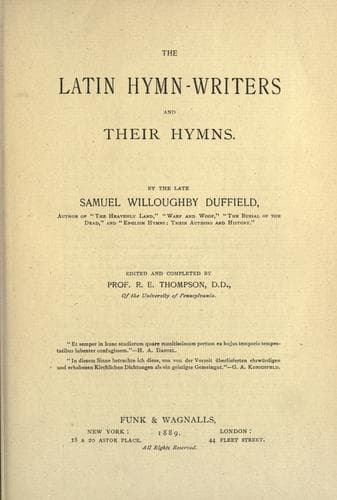
The Latin Hymn-writers and Their HymnsDuffield, Samuel Willoughby
Religion
The Latin Hymn-writers and Their Hymns
Duffield, Samuel Willoughby
Hymns, Latin -- History and criticism
The translators have had a hard problem in Bernard’s poem, and but few
have attempted to “bend the bow of Ulysses.” Dr. Neale has achieved the
most popular and useful result, in the version from which “Jerusalem the
Golden” has been extracted, but he does not pretend to literalness. “My
own translation,” he says, “is so free as to be little more than an
imitation.” Dr. Coles has gone straight away from the dactyls and made a
version in anapests—a metre which does not do justice to Bernard.
Archbishop Trench has rendered a few lines in the same measure as the
original. I have myself followed (in 1867) the exact metre and rhyme of
the original poem; but such a version is rather curious than useful. The
translation signed by “O. A. M., Cherry Valley,” is in its typography,
while fine and clear, affectedly antique. The metrical power of this
version is inferior. It is dactylic but not fluent, and does not at all
represent the original. That by Mr. Gerard Moultrie is praised by Dr.
Trench as metrically close and poetically beautiful. I have no
hesitation in saying it is the best version which has appeared in
English. It seems to keep both to the spirit and the letter of the
original, and is in all respects a remarkable achievement. It, however,
omits the double rhyme, and thus avoids the chief difficulty of a
reproduction of the form of the original. That by Rev. Jackson Mason
(1880) will not stand a comparison with Mr. Moultrie’s, as it halts and
breaks in its measure and produces an effect on the ear far from
pleasant.
The difficulty of translation is due entirely to the character of the
verse. Bernard himself declares “unless that spirit of wisdom and
understanding had been with me, and flowed in upon so difficult a metre,
I could not have composed so long a work.” Not that this form of verse
was original with him. Peter Damiani has used it in one of his hymns to
our Lord’s mother:
“O miseratrix, O dominatrix, praecipe dictu
Ne devastemur, ne lapidemur, grandinis ictu.”
And, to go farther back still, a certain Theodulus, who lived in the
reign of the Emperor Zeno (474-91) wrote a poem of nine hundred lines on
Bernard’s own theme, _De Contemptu Mundi_, in the same metre:
“Pauper amabalis et venerabilis est benedictus
Dives inutilis insatiabilis, est maledictus.
Qui bona negligit et mala diligit intrat abyssum;
Nulla pecunia, nulla potentia liberat ipsum.”
A glance will show the nature of this trouble which the patient Bernard
encountered. Take the two lines:
“Hora _novíssima_, tempora _péssima_ sunt, _vigilémus!_
Ecce _minaciter_, imminet _árbiter_, ille _suprémus_.”
That is:
“These are the _látter_ times,
These are not _bétter_ times,
Let us stand _waiting!_
Lo, how with _áwfulness_,
He, first in _láwfulness_,
Comes, _arbitrating!_”
Public-domain text, read in full here on John Shaqi.
Reviews
Reviews
No reviews yet
Be the first to share your thoughts on this work.
Elsewhere in the archive
Join the Discussion
Join the discussion
Sign in to leave a comment or review.
Sign InorCreate an account