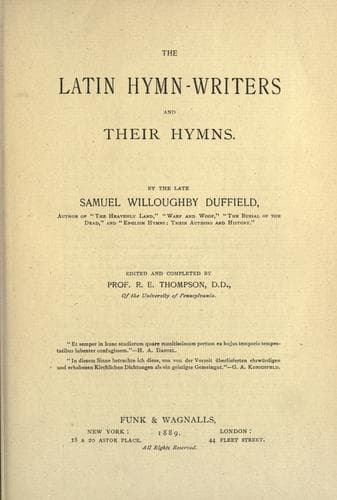
The Latin Hymn-writers and Their HymnsDuffield, Samuel Willoughby
Religion
The Latin Hymn-writers and Their Hymns
Duffield, Samuel Willoughby
Hymns, Latin -- History and criticism
We must then add the German names of Schlosser, and Simrock, and
Fortlage, and Stadelmann, and Jacob Grimm, and Königsfeld, and Bässler,
and Kayser, and Kehrein, and Morel. Wackernagel and Koch, the great
historians of German hymnology, have also done admirable service in
prefixing the Latin hymns to the earlier part of their collections and
histories of German praise. There is a host of lesser names, and there
have been some separate discoveries worthy of note. Thus the English
ritualists, under the lead of Newman and Neale, unearthed some capital
lyrics. The _Hymni Ecclesiae_ of Cardinal J. H. Newman, being half
derived from the Paris Breviary, contain hymns which are scarcely to be
found elsewhere—many of them, as our Index will show, being accessible
only in those pages. The _Sequentiae Medii Aevii_ of Dr. John Mason
Neale also bring to us texts which are extremely scarce. Archbishop
Trench, in his collection of eighty hymns, has avoided anything like
Romanism even to the occasional expurgation of a phrase; but he has
given us a few hymns which are difficult to procure. Königsfeld’s
selection of one hundred is admirable; and Bässler’s and Simrock’s
little books have made a very good choice. More recently still Professor
F. A. March, of Lafayette College, has prepared a selection of one
hundred and fifty of these hymns for the use of institutions of
learning; and this, for every purpose, is the finest and most
satisfactory series of texts at our command. The ordinary student can
learn much from this before he needs to attempt the larger and more
expensive works.
In making an exhaustive index of all the originals before us, these
collections soon dwindle into a very diminutive form. There are about
three thousand five hundred hymns in the various books. And they are of
all sorts—good, bad, and indifferent. The good are the pure and true
utterance of pious spirits—such lyrics as the _Veni, Redemptor_, and the
_Veni, Sancte Spiritus_, and the _Vexilla Regis_. The positively bad are
those which are either poor in execution—a common fault—or decidedly
defective in religious tone. Many so-called “hymns” are nothing but
plagiaries or parodies upon older compositions. Some are debased into
mere patchwork. There are a few which are macaronic, and a great many in
which poverty of phrase is helped out by wholesale pilfering. Moreover,
it is easy to find those which are highly objectionable in point of
taste and theology, to say nothing of prosody or Protestantism. And if
Protestants are principally energetic in restoring and editing these
hymns, to the frank and generous extent of overlooking what is
unpleasant in them, it ought to follow that they should not be blamed
for preferring only those lyrics in which the broad and Christian fervor
of devout souls can be observed.
Public-domain text, read in full here on John Shaqi.
Reviews
Reviews
No reviews yet
Be the first to share your thoughts on this work.
Join the Discussion
Join the discussion
Sign in to leave a comment or review.
Sign InorCreate an account