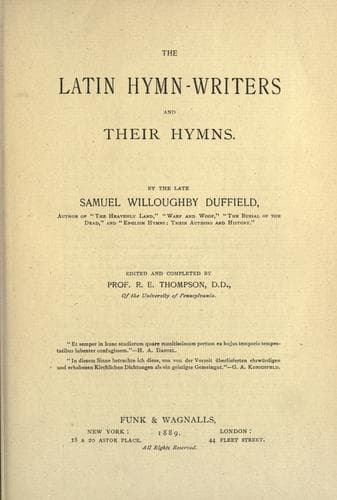
The Latin Hymn-writers and Their HymnsDuffield, Samuel Willoughby
Religion
The Latin Hymn-writers and Their Hymns
Duffield, Samuel Willoughby
Hymns, Latin -- History and criticism
Other and later laborers are such as Cardinal Thomasius (Rome, 1741),
who follows upon the traces of George Cassander, the Liberal Catholic
(Paris, 1616). We are possibly more indebted to Cassander than to
Thomasius for the correct designation of a good deal of the authorship.
Both of these editors collate the text with other versions, and thus
prepare the way for later and more accurate work. Both depend to a
notable degree upon the book of George Fabricius (Basle, 1564), which is
quite rare; although Thomasius’ works are said by Daniel to be
sufficiently uncommon in Germany, as they certainly are in America. The
recent republication of the Mozarabic Breviary in J. P. Migne’s
_Patrologia_ brings this volume, however, within easy reach.
Thus we are naturally led to speak of the sources of the hymns
themselves—sources from which these editors have secured them. As a part
of religious worship they were incorporated into the various breviaries,
of which hundreds must have been in use before the unification begun by
the Church of Rome in the sixteenth century. Besides these church books,
there were collections of hymns alone made by mediaeval schools, whose
manuscripts still exist in European libraries.
The only method by which to ascertain the number and extent of these
treasures was to gather and classify them. And strangely enough this
labor has been performed by Protestants rather than by Catholics.
Cassander’s book was forbidden at Rome, as he was what now would be
called an Old Catholic; Luther, George Fabricius, and Hermann Bonn were
in no better odor of sanctity; and for our own times the standard work
is that of Herman Adelbert Daniel, who was a Lutheran professor at
Halle, while close behind him come several others of the same religious
belief.
The necessary and highly difficult task of getting the materials
together has been exhaustively performed. Professor Daniel’s
investigations extended to the original copies in monasteries and abbeys
almost without number. But F. J. Mone enlarged even upon this. Daniel’s
_Thesaurus_ in five volumes was completed in 1856—having been several
years in course of publication—and it stands as yet unrivalled. Mone’s
_Lateinische Hymnen des Mittelalters_ appeared in 1853-55, and was
therefore available for the conclusion of Daniel’s great work. Its value
consists in the fact that it is derived exclusively from manuscripts and
from material hitherto untouched. The Germans, indeed, have made Latin
hymnology a special branch of study, considering that it is profitable
to them for its value religiously and historically. From old Flacius
Illyricus’ appendix to the _Catalogus Testium Veritatis_ has been
recovered the original of Bernard of Cluny’s “Jerusalem the Golden”—a
poem which would never have been known by us if this same Matthias
Flacius had not preserved it as a testimony against the corrupt state of
the Church.
Public-domain text, read in full here on John Shaqi.
Reviews
Reviews
No reviews yet
Be the first to share your thoughts on this work.
Join the Discussion
Join the discussion
Sign in to leave a comment or review.
Sign InorCreate an account