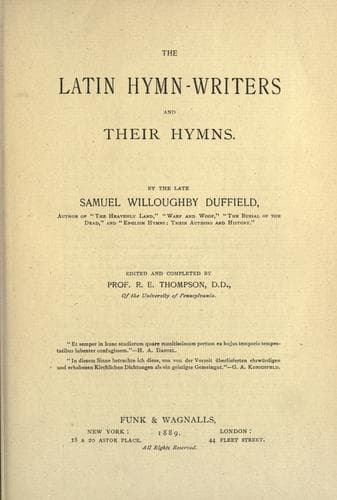
The Latin Hymn-writers and Their HymnsDuffield, Samuel Willoughby
Religion
The Latin Hymn-writers and Their Hymns
Duffield, Samuel Willoughby
Hymns, Latin -- History and criticism
Having secured their prize, the Dominicans showed that they knew how to
use it. The order was, on one side of it, a great educational
institution to select and train young men to fight the intellectual
battles of the Church. The young Dominican at once put on the yoke of
the “course of study” (_Ordo Studiorum_), which had been prescribed by
the General Chapter, and proceeded as far toward the highest dignities
and responsibilities of learning as his abilities were thought to
warrant. The decision on this point rested with the General of the
Order, who at this time was John of Germany, the fourth in the
succession begun by Dominic. He selected for Thomas as his best teacher,
Albert of Bollstadt, better known as Albert the Great (Magnus), who was
teaching in the monastic school at Koeln (Cologne), and who had the
reputation of having absorbed all that Aristotle knew, and worked up his
teaching into a harmony of Christian theology with Greek philosophy.
According to his biographers generally, Thomas was sent at once to Koeln
in 1245, and accompanied Albert when he proceeded to Paris in that same
year to take his degree as Doctor of Theology, returning with him in
1248. Dr. Heinrich Denifle, however, assigns 1248 as the year when
Thomas came to Koeln from Italy, and limits their intercourse as master
and scholar to the two years required by the rules of the order. Whether
their relations as such extended over five years or were limited to two,
they were enough for the formation of a life-long friendship based on
mutual respect and admiration. Strangely enough the young Italian from
the garrulous South was noted more for silence than for speech among the
students at Koeln. He had found a teacher whom he thought worth hearing
in silence, and he heard to better purpose than his associates. _Bos
mutus_, a dumb ox, they called him. Albert foretold that “the sound of
his bellowing in doctrine would yet go through the whole world.”
In 1250, the year when Frederic II. died, Thomas proceeded to Paris by
direction of the General of the Order. In that mother university of
Christendom the Dominicans were allowed by their rule to receive the
doctorate—in that and no other. For one year the candidate must hear and
dispute in the Dominican school on St. Jacques Street; for another he
must teach, but without ascending the cathedra, from which authoritative
decisions were expected. But in Thomas’s case these two years of his
Parisian apprenticeship were prolonged to seven. The university
quarrelled with the representatives of the Mendicant orders just as
Thomas was about to take his degree, and in the five years’ struggle
which ensued all ordinary relations and procedures were suspended. For
some time, indeed, the university itself was dissolved, to evade the
bull of excommunication which the Pope aimed at it in the interest of
the Mendicants.
Public-domain text, read in full here on John Shaqi.
Reviews
Reviews
No reviews yet
Be the first to share your thoughts on this work.
Elsewhere in the archive
Join the Discussion
Join the discussion
Sign in to leave a comment or review.
Sign InorCreate an account