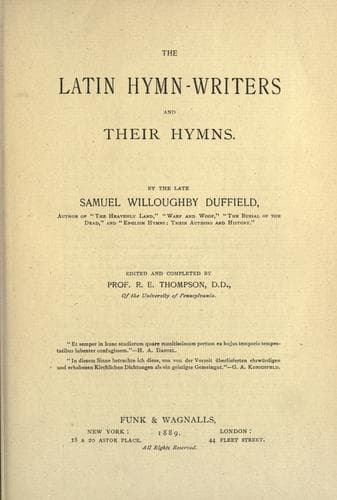
The Latin Hymn-writers and Their HymnsDuffield, Samuel Willoughby
Religion
The Latin Hymn-writers and Their Hymns
Duffield, Samuel Willoughby
Hymns, Latin -- History and criticism
In 1656 William of St. Amour sent the Pope his treatise _Concerning the
Dangers of these Last Times_ (_De Periculis Novissimorum Temporum_), in
which he pleaded the cause of the university against the Mendicants, and
told some home-truths about the greediness, the lawlessness, and the
encroachments of the friars, but in an angry and excited tone, which
harmed his cause. Both the assailed orders put forward their ablest men
to make answer. For the Franciscans spoke John Fidanza, better known as
John Bonaventura, who had come to Paris in the heat of the conflict, and
had been delayed, as Thomas was, in obtaining his degree.
John was older than Thomas by several years, having been born in 1221.
He had been recovered from an apparently mortal illness through the
prayers of Francis of Assisi in his third year, and then received the
name Bonaventura from the good man’s own lips. He entered the order in
his twenty-second year, and studied in Paris under Alexander of Hales
and John of Rochelle. The devout humility of the man, and his purity of
character, produced as deep an impression upon his teachers as Thomas
had produced upon his by the force and keenness of his intellect.
Alexander used to say that “in Brother Bonaventura Adam seems not to
have sinned.” John was probably the most perfect exemplar of the spirit
of Francis of Assisi that was to be seen in the second generation of the
order. Not by intellectual force, but by humble ministry to the
commonest human needs, by the infection of an all-embracing love and the
close imitation of our Lord’s humanity, he would save the world from its
wanderings. Thomas and he were the best possible representatives of
their respective orders, and it speaks well for both men that their
differences only bound them more intimately in friendship. Each
reverenced what was strongest in the other. When Thomas asked to see the
books by whose help John had acquired his Christian erudition, the
Franciscan pointed him to a crucifix, and said that from that he had
learned all that he ever knew.
Public-domain text, read in full here on John Shaqi.
Reviews
Reviews
No reviews yet
Be the first to share your thoughts on this work.
Elsewhere in the archive
Join the Discussion
Join the discussion
Sign in to leave a comment or review.
Sign InorCreate an account