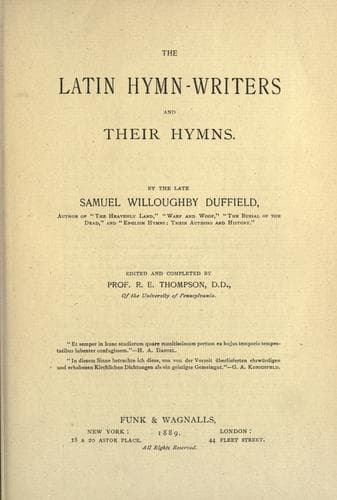
The Latin Hymn-writers and Their HymnsDuffield, Samuel Willoughby
Religion
The Latin Hymn-writers and Their Hymns
Duffield, Samuel Willoughby
Hymns, Latin -- History and criticism
Their answers to William of St. Amour reflect the character of the men.
Bonaventura defended the mendicant form of the monastic life as an
ideal; but without admitting the truth of the dark picture William had
drawn, he conceded that serious abuses had crept in, and that already
there was need of a reformation unless matters were to be let grow
worse. Thomas makes no concessions whatever. He entitles his book
_Against those who Assail the Worship of God and the Monastic Life_
(_Contra Impugnantes Dei Cultum et Religionem_). William and all who
hold with him are the enemies of God and of His Church. The critics of
the Mendicant rule are standing in the way of the forces which are sent
of God to win the world to Christ. The monk, and especially the
mendicant friar, is the only thorough Christian who keeps to the
“counsels of perfection” our Lord gave His disciples, as well as to the
precepts of obedience obligatory upon all. William uttered false and
damnable doctrine when he tried to limit them to a purely ascetic life.
They have the right to teach as well as to pray and mourn, and the Pope
has power to open to them the doors of every secular college by his
mandate.
The controversy was brought to an end in 1257, when Pope Alexander IV.
at Anagni formally condemned the book of William of St. Amour, and bound
the plenipotentiaries of the university by an oath to admit the
Mendicants to their former footing in the university. And to signalize
the victory of the friars, Thomas and Bonaventura were admitted to the
doctorate on the same day, October 23d, 1257.
Public-domain text, read in full here on John Shaqi.
Reviews
Reviews
No reviews yet
Be the first to share your thoughts on this work.
Elsewhere in the archive
Join the Discussion
Join the discussion
Sign in to leave a comment or review.
Sign InorCreate an account